
Space planning is the process of organizing interior areas to maximize function, comfort, and efficiency before renovation work begins. For homeowners in Singapore's compact HDB flats and business leaders managing commercial fit-outs, the role of space planning in renovation is not optional. It is the decision that determines whether a finished space works or frustrates. Get it right before construction starts, and you avoid the most expensive mistake in renovation: changing your mind after walls go up.
Why is space planning critical in home and office renovations?
Space planning is the functional foundation of any renovation. Without it, contractors build what they are told, not what you actually need. The result is a finished room that looks fine but forces awkward workarounds every single day.
Poor planning produces regret. Homeowners who prioritize function before finishes report higher satisfaction and fewer regrets about space use five years after renovation. That gap between satisfied and dissatisfied owners almost always traces back to one decision: whether they planned the layout before they chose the tiles.
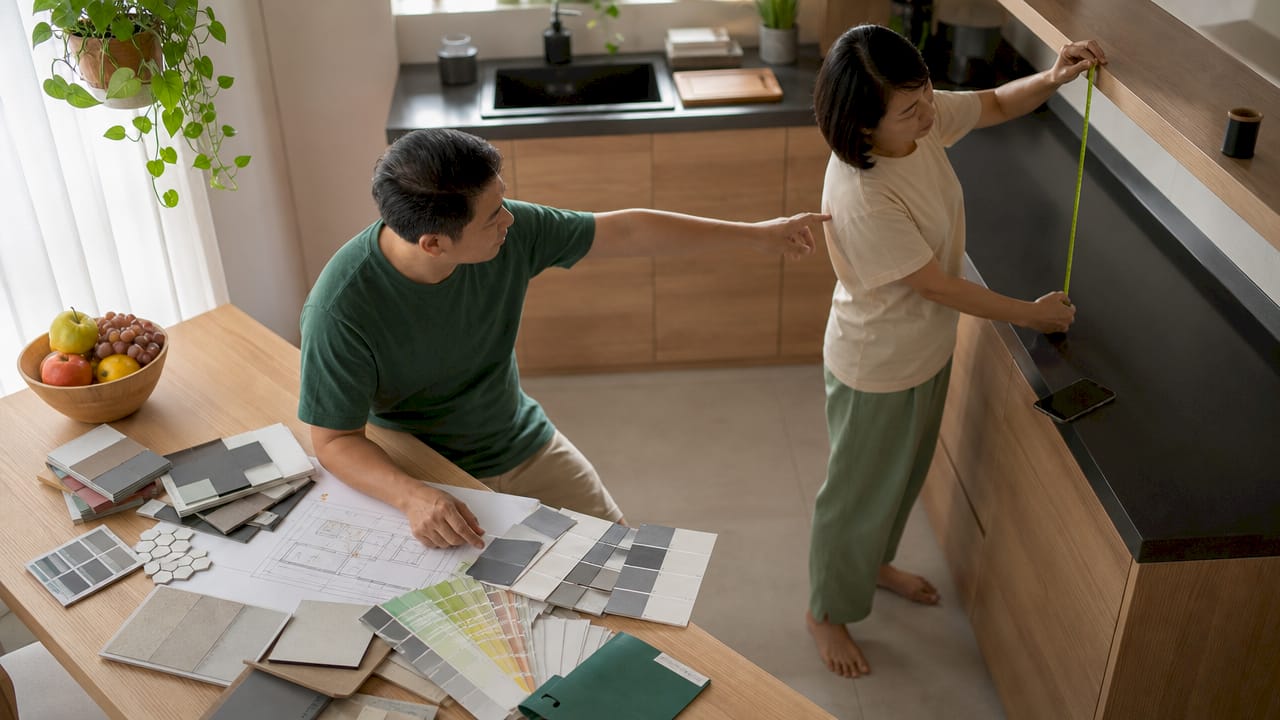
The cost argument is equally clear. Renovation changes after execution are a common and expensive problem. Moving a wall, relocating a power point, or repositioning a kitchen island mid-build can cost several times more than getting the layout right at the planning stage.
The stakes differ between residential and commercial projects, but the principle holds in both. A homeowner in a four-room HDB flat needs to plan for storage, circulation, and daily routines. A business leader fitting out a 3,000 square foot office needs to map focus zones, meeting areas, and collaboration spaces. Both suffer the same consequence when planning is skipped: a space that fights the people using it.
- Residential: Poor layout forces furniture into awkward positions, blocks natural light, and creates cramped circulation paths.
- Commercial: Unplanned offices generate bottlenecks, underused meeting rooms, and wasted real estate.
- Both: Mid-construction changes inflate budgets and delay completion.
What key elements define effective space planning?
Effective space layout strategy starts with circulation. Primary traffic paths require 30–36 inches of clearance to maintain comfort. In Singapore's smaller units, this number is non-negotiable. Squeeze a corridor below that threshold and the space feels tight regardless of how well it is decorated.
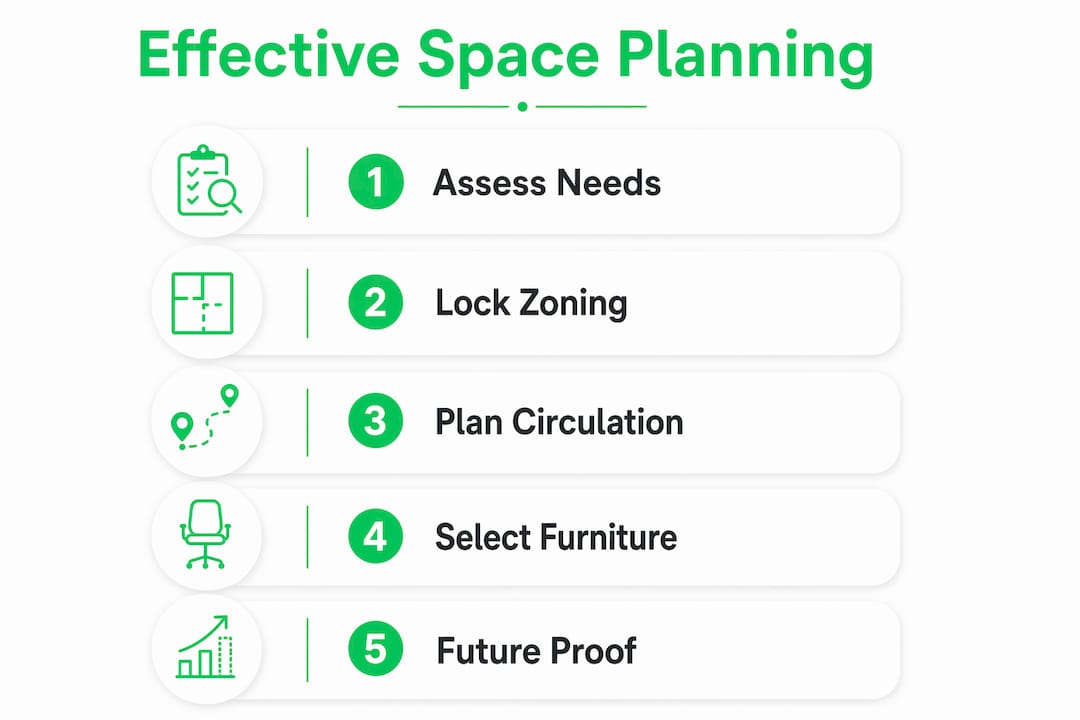
The core elements of a well-planned layout follow a clear sequence:
- Zoning. Divide the space into purpose-driven areas: sleeping, cooking, working, socializing. In commercial settings, map focus zones, collaboration areas, and flexible spaces before assigning square footage.
- Adjacency. Place related functions next to each other. A kitchen should sit adjacent to a dining area. In an office, a print station should not require a cross-floor walk.
- Scale and proportion. Match furniture size to room dimensions. Oversized sofas in a small living room eliminate circulation and make the space feel smaller, not larger.
- Accessibility. Accessible routes must connect all arrival points to interior spaces. The ADA standard requires a turning space clearance of 60 inches in diameter or a T-shaped equivalent within a 60-inch square. Door swings and millwork reduce available clearance, so realistic testing before finalizing layouts is critical.
- Visualization. Use 2D floor plans to test layouts on paper, then confirm with 3D renders before committing to construction. Changes cost nothing at this stage.
Pro Tip: Lock your zoning and circulation plan before selecting any furniture or finishes. Décor decisions made before the layout is confirmed almost always require expensive corrections later.
Space planning should be treated as an evolving framework that accounts for human behavior, safety codes, and future needs. It is not a one-time sketch. It is a living document that guides every downstream decision from electrical placement to cabinet depth.
How does space planning improve commercial renovation efficiency?
Office space planning starts with one uncomfortable fact: average office occupancy sits around 45%. That means most businesses are paying for space that sits empty most of the day. Effective planning corrects this by analyzing actual usage patterns before designing the new layout.
The planning process maps three types of workspace:
- Focus areas: Private or semi-private zones for deep work, calls, and concentration tasks.
- Collaboration areas: Open tables, breakout rooms, and informal meeting spaces sized to actual team usage.
- Flexible zones: Spaces that shift between functions depending on the day, reducing the total footprint needed.
Right-sizing and zoning increase usable seats without increasing footprint. That is a direct reduction in real estate cost per employee. For Singapore businesses paying premium commercial rents, this calculation matters.
| Without space planning | With space planning |
|---|---|
| Fixed desks for every employee | Flexible seating matched to actual occupancy |
| Oversized meeting rooms used rarely | Right-sized rooms booked consistently |
| Storage consuming prime floor area | Consolidated storage freeing usable workspace |
| Bottlenecks at shared equipment | Equipment positioned to match traffic flow |
Beyond cost, layout decisions directly affect employee experience. Renovation layout improvements support better psychological well-being by simplifying movement, improving storage access, and reducing daily frustrations. A well-planned office does not just look professional. It makes work feel less effortful.
Future-proofing is the final commercial benefit. Modular, flexible layouts accommodate team growth and technology changes without requiring a full refurbishment. Planning for adaptability now avoids another round of construction costs in three years.
What practical strategies help you plan a space renovation effectively?
Successful space renovation tips share one common thread: start with behavior, not blueprints. Before drawing a single line, document how you actually use the space today.
- Audit daily activities. List every task performed in the space and where it happens. Identify friction points: the drawer that is always blocked, the desk that gets no natural light, the meeting room that is always too small.
- Draft multiple layout options. Never commit to the first plan. Test at least two or three configurations on paper before involving contractors. Each option reveals trade-offs you would not otherwise see.
- Prioritize function before aesthetics. Finishes, colors, and furniture styles are reversible. Structural decisions are not. Lock the layout before selecting materials.
- Use professional designers and visualization tools. A qualified interior designer or space planner brings knowledge of clearance standards, code compliance, and spatial proportion that most owners lack. 3D visualization tools let you walk through the space before it is built.
- Document your assumptions. Documenting assumptions early ensures that contractors, engineers, and designers all work from the same approved layout. This process, sometimes called a pre-execution lock, prevents costly rework caused by miscommunication.
- Balance flexibility with compliance. Singapore's Building and Construction Authority sets specific requirements for commercial spaces. Residential renovations in HDB flats follow Housing and Development Board guidelines. Both must be factored into the layout before work begins.
Pro Tip: Measure your existing furniture before finalizing any layout. A sofa that fits perfectly in your current home may block the circulation path in your renovated space.
The impact of space planning extends beyond the renovation itself. Spaces planned around real behavior require fewer modifications over time, which means lower maintenance costs and higher long-term satisfaction.
Key Takeaways
Space planning is the single most cost-effective step in any renovation because it eliminates the most expensive problem in construction: changing a layout after work has started.
| Point | Details |
|---|---|
| Plan function before finishes | Lock zoning and circulation before selecting materials or furniture. |
| Circulation clearance matters | Primary traffic paths need 30–36 inches of clearance to feel comfortable. |
| Commercial occupancy is low | Average office occupancy sits around 45%; right-sizing recovers wasted real estate. |
| Document assumptions early | A pre-execution lock aligns contractors and designers, reducing costly rework. |
| Behavior drives layout | Audit how you use the space today before drawing any renovation plans. |
Why I think most Singapore renovations get space planning backwards
Most renovation conversations in Singapore start with the same question: "What style do you want?" That question is asked before anyone has mapped how the family moves through the home or how the team actually uses the office. Style is the last decision, not the first. Treating it as the first decision is the single biggest reason renovations disappoint.
I have seen this pattern repeatedly in Singapore's property market. A homeowner spends weeks choosing marble finishes for a kitchen, but the kitchen layout puts the refrigerator behind the oven door swing. A business leader approves a beautiful open-plan office, but the layout places the only printer at the far end of the floor from the people who use it most. Both situations are entirely preventable with one hour of honest layout analysis before construction begins.
Singapore's residential units are genuinely small by global standards. A four-room HDB flat averages around 90 square meters. Every square meter carries real cost, and every poorly placed wall or cabinet wastes space that cannot be recovered without another round of hacking and rebuilding. The margin for error is thin. That is exactly why space planning matters more here than in markets where square footage is generous.
The good news is that the tools available today, from 3D visualization software to professional space planners, make it easier than ever to test a layout before committing to it. The barrier is not technology. The barrier is the habit of skipping the planning step because it feels less exciting than choosing finishes. Resist that habit. The renovation you will be proud of in ten years is the one that works, not just the one that photographs well.
— Rayner
Honestbuilders can handle your renovation space planning in Singapore
Planning a renovation in Singapore means navigating HDB guidelines, commercial building codes, and the practical reality of limited square footage. Honestbuilders brings hands-on experience across HDB flats, condos, landed properties, and commercial spaces island-wide.

Honestbuilders covers the full scope of residential and commercial renovation work: hacking, electrical, plumbing, tiling, carpentry, painting, and space planning. Every project runs on two principles: workmanship and accountability. No hidden charges, no runaround. If you want a layout that works before a single wall goes up, WhatsApp Honestbuilders at +65 9447 9696 for a free, no-obligation quote.
FAQ
What is space planning in a renovation?
Space planning is the process of organizing interior areas to maximize function, flow, and comfort before renovation work begins. It determines zoning, circulation paths, furniture placement, and compliance requirements before any construction starts.
Why does space planning matter more than style?
Layout mistakes cannot be fixed without demolition and rebuilding. Homeowners who prioritize function before finishes report higher long-term satisfaction and fewer regrets than those who focus on aesthetics first.
How much clearance do circulation paths need?
Primary traffic paths require 30–36 inches of clearance to maintain comfort. In Singapore's compact HDB units, staying within this standard prevents the cramped feeling that affects even well-decorated spaces.
How does space planning reduce renovation costs?
Planning the layout before construction eliminates mid-build changes, which are among the most expensive problems in renovation. Documenting the approved layout early aligns all contractors and prevents rework caused by miscommunication.
Is space planning different for commercial renovations?
Commercial space planning maps focus zones, collaboration areas, and flexible spaces based on actual occupancy data. Average office occupancy sits around 45%, so right-sizing layouts recovers wasted real estate without increasing the total footprint.