
Hire a licensed renovation contractor who obtains the hacking permit and manages demolition, safety controls, and inspections from start to finish. That is the one-sentence verdict, and everything else in this guide supports it. A permit sitting in a drawer does not protect your flat's structure or your family's health; a contractor who actively tracks it does.
Before you sign anything, do three things:
- Verify the contractor's license and insurance directly with the issuing body, not just from a business card.
- Confirm in writing that they will pull the permit and give you the permit number once issued.
- Get an itemized written scope with milestone payments tied to inspection sign-offs, not just calendar dates.
Lead paint rules from the EPA apply to older housing stock, and contract standards from bodies like the CSLB exist for a reason: too many renovation disputes trace back to a handshake deal. A contractor like Honest Builders that puts scope, permit responsibility, and payment terms on paper from day one is the standard to hold every bid against.
Key Takeaways
A licensed contractor who pulls the permit, screens for hazards, and ties payment to inspection sign-offs is the single most reliable way to hire safely for hacking work.
| Point | Details |
|---|---|
| Verify credentials directly | Check the license through your state's public database and confirm insurance by calling the insurer directly. |
| Demand permit numbers | Require the contractor to provide the actual permit number, not just a verbal promise it was filed. |
| Insist on written contract terms | Get itemized scope, change-order rules, and milestone payments tied to passed inspections before signing. |
| Test for hazards on older homes | Pre-1978 properties need lead testing under EPA rules, plus asbestos screening before hacking begins. |
| Consider Honest Builders | Honest Builders provides written scopes with permit-handling terms and milestone payments tied to inspection sign-offs. |
Table of Contents
- What Does a Hacking Contractor Actually Handle?
- How Do You Choose a Contractor Who Will Handle the Permit Correctly?
- Safety, Hazardous Materials, and What U.S. Rules Require
- Contract Essentials and a Sample Payment Schedule
- Timeline and Cost Drivers for Hacking Work
- Who Actually Pulls the Permit: You or the Contractor?
- How Do You Verify a Contractor's License and Insurance?
- How Do You Track a Hacking Permit Application?
- What Regulations Govern Hacking and Demolition Work?
- What Happens After the Permit Is Approved?
- Get a Written Scope and Permit Confirmation From Honest Builders
- Frequently Asked Questions
- Sources
What Does a Hacking Contractor Actually Handle?
A hacking contractor's job goes well past swinging a sledgehammer. Before any wall comes down, a competent crew disconnects electrical and plumbing lines feeding that section, sets up dust containment barriers, and checks whether the wall is load bearing. Skipping that structural check is how ceilings crack two floors up.
Once demolition starts, the work includes:
- Utility disconnects and capping, done before hacking begins
- Dust containment using barriers and negative-pressure setups where needed
- Structural assessment to confirm load bearing versus non load bearing walls
- Controlled removal of walls, flooring, or fixtures
- Debris sorting and haul away, separating recyclable material from waste
- Coordinating required inspections at each hold point
Permit tasks run in parallel. A qualified contractor pulls the demolition permit, schedules the inspections tied to it, and collects the sign-offs before moving to the next phase. Interior demolition projects commonly trigger permit requirements whenever the work touches structural elements, electrical, plumbing, HVAC, or fire-rated assemblies, so this is not optional paperwork on most jobs.
Pro Tip: Ask every bidder to show recent permit numbers and inspection reports from comparable jobs, and put that requirement into the written estimate itself. A contractor who hesitates here is telling you something.
How Do You Choose a Contractor Who Will Handle the Permit Correctly?
Screening a hacking contractor is not that different from vetting a surgeon. You want references, proof of credentials, and a paper trail. Here's the order that actually works.
- Start with referrals, then cross-check the contractor against your state licensing board's public database.
- Verify insurance by asking for a certificate of insurance (COI) directly from the insurer, not a scanned PDF the contractor emails you.
- Ask about their permit-handling policy in plain terms: who applies, whose name is on the application, and what happens if an inspection fails.
- Confirm hazardous-material screening is included in the estimate, not billed later as a surprise.
- Request references and photos from at least two completed hacking jobs of similar scope.
Once you're ready to sign, the contract itself needs specific clauses:
- Itemized scope of work, line by line, not a vague "demo and haul" summary
- Written change-order procedure requiring your approval before any extra charge
- Milestone-based payment schedule tied to completed, inspected work
- Insurance and indemnity language naming you as an additional interest where applicable
- Explicit permit-handling responsibility, including whose name goes on the application
A written contract with these exact elements is what separates a smooth project from a stalled one, according to guidance from California's contractor licensing board. Many contractor guides also recommend checking permit histories through municipal portals before you commit.
Pro Tip: Require the contractor to print permit numbers directly on invoices, and make copies of inspection sign-offs a condition of your final payment. This single habit prevents most permit-related disputes.
Safety, Hazardous Materials, and What U.S. Rules Require
Older homes hide risks that a demolition crew has to plan for before the first hole goes in the drywall. If your home was built before 1978, lead paint is a real possibility, and EPA lead-based paint regulations require identification and safe management of that hazard during renovation and demolition. Asbestos is the other common concern, often found in older flooring, insulation, or ceiling texture.
A contractor handling this correctly will typically:
- Order lead paint testing before hacking begins on pre-1978 structures
- Screen for asbestos in flooring, insulation, and textured ceilings
- Set up containment and negative-pressure controls when hazards are confirmed
- Isolate utilities safely before any wall or floor removal
- Dispose of waste through licensed, compliant channels, not a random dumpster
Callout: If lead or asbestos testing comes back positive, federal rules require certified testing protocols and licensed abatement contractors, not a general hacking crew improvising with extra plastic sheeting.
Job-site safety more broadly falls under OSHA standards, which govern everything from fall protection to respiratory equipment on demolition sites. A contractor who cannot describe their hazmat screening process without stumbling is not one you want inside load-bearing walls.
Contract Essentials and a Sample Payment Schedule
Get these clauses into every hacking contract, no exceptions:
- Itemized scope of work covering every wall, fixture, and surface being removed
- Explicit statement of who pulls the permit and whose name is on it
- Written change-order rules requiring your signed approval before extra cost
- Certificate of insurance and indemnity language protecting you
- Warranty terms covering workmanship after the hacking phase
- Inspection sign-off required before any final payment is released
- Lien-waiver obligations so subcontractors cannot claim against your property later
A workable milestone schedule looks like this:
- Deposit on signing (covers initial mobilization and permit filing)
- Payment at pre-demolition milestone, once permits are confirmed issued
- Mid-project payment after structural hacking is complete
- Holdback released only after passed inspection
- Final payment on receipt of the signed inspection certificate
This kind of milestone structure shifts risk off the homeowner. If the contractor wants abatement or permit costs paid before proof of compliance, that is your leverage to push back.
Timeline and Cost Drivers for Hacking Work
Permit processing windows vary by municipality, but most homeowners should budget one to three weeks before demolition can legally start. Actual hacking work on a single room typically runs a few days to two weeks depending on scope, with inspections scheduled at hold points along the way before follow-on trades like electrical or tiling begin.
Cost swings on a few clear factors:
- Structural complexity, especially load bearing wall removal requiring engineering input
- Hazardous-material testing and, if positive, abatement costs
- Haul-away and disposal fees, which scale with debris volume
- Permit fees themselves
- Contractor experience and insurance overhead baked into the bid
Cost callout: Permit fees for mid-size remodels often fall within a moderate range common in many U.S. municipalities in many U.S. municipalities, and inspection delays can push your schedule back by days or weeks. Confirm upfront who is paying those fees.
Red Flags and Questions to Ask On-Site
Watch for these warning signs during any estimate visit:
- No license shown, or reluctance to produce one
- Demands for full payment up front, before work starts
- No written change-order policy
- Missing certificate of insurance
- Vague or evasive answers about who pulls the permit
- Dodges questions about lead or asbestos screening
Ask directly: "Who pulls the permit? Can you show me a recent permit number? Do you test for lead and asbestos, and is abatement included if results are positive?"
- Confirm license and insurance status directly with the issuing agency, not the contractor.
Who Actually Pulls the Permit: You or the Contractor?
In most residential hacking jobs, the contractor pulls the permit, not the homeowner. Most professional general contractors handle permit acquisition as a standard part of their service, and that arrangement makes sense: the permit typically requires proof of licensing that only the contractor holds.
That said, "the contractor handles it" cannot be the end of your understanding. You are still the property owner, and your name is on the deed even if it is not on the permit application. That means you carry the liability if the work turns out to be unpermitted, regardless of what your contractor promised verbally.
Homeowner responsibilities that survive even with a contractor pulling the permit include confirming the permit was actually filed (not just promised), keeping a copy of the issued permit for your own records, and verifying that inspections tied to the permit actually happened and passed. Experienced contractors typically coordinate the entire inspection process as part of their scope, but "typically" is not "always."
The practical split looks like this: the contractor files the application, pays the permit fee (often built into your contract price), schedules inspections, and manages inspector visits on-site. You verify the permit number exists, confirm it matches your address and scope of work, and keep documentation in case you sell the property later. A missing or mismatched permit number is one of the most common issues that surfaces during home resale inspections, sometimes years after the original hacking work.
How Do You Verify a Contractor's License and Insurance?
Do not take a contractor's word for their credentials. Every state maintains a public licensing board database where you can search by contractor name or license number and see the license status, any disciplinary actions, and the license classification (which matters, since not every general license covers structural demolition work).
Insurance verification takes one extra step most homeowners skip: calling the insurer directly. A certificate of insurance (COI) can be forged or expired, and a five-minute phone call to the insurance company listed on the COI confirms it is current and actually covers the contractor you are hiring. Ask specifically about two types of coverage:
General liability insurance covers property damage, like a hacking crew accidentally compromising a shared wall or damaging a neighboring unit during demolition. Workers' compensation insurance covers injuries to the crew on your property. Without workers' comp, an injured worker on your job site could potentially pursue a claim against you as the property owner.

Ask the contractor to name you as an additional insured on the general liability policy for the duration of the project. This is standard practice for larger interior demolition scopes and costs the contractor little to arrange. If a bidder resists this request, treat it as a signal, not a technicality.
How Do You Track a Hacking Permit Application?
Once your contractor files the permit application, tracking it does not require guesswork. Most municipal building departments now run online permit portals where you can search by address and see the application status, assigned permit number, and inspection history in real time.
Ask your contractor for the permit number as soon as it is issued and search it yourself on your local building department's site. This takes five minutes and confirms the application is real, matches your property, and covers the correct scope. If the contractor cannot provide a permit number within a reasonable window after filing, or if the number does not show up in the municipal system, that is worth a direct conversation before hacking begins.
Inspections tied to the permit typically happen at defined hold points: after demolition but before any new framing or utility work starts, and again before walls are closed up if plumbing or electrical was touched. Coordinating these inspections is a core part of what an experienced contractor manages, including rescheduling if an inspector flags an issue on the first visit.
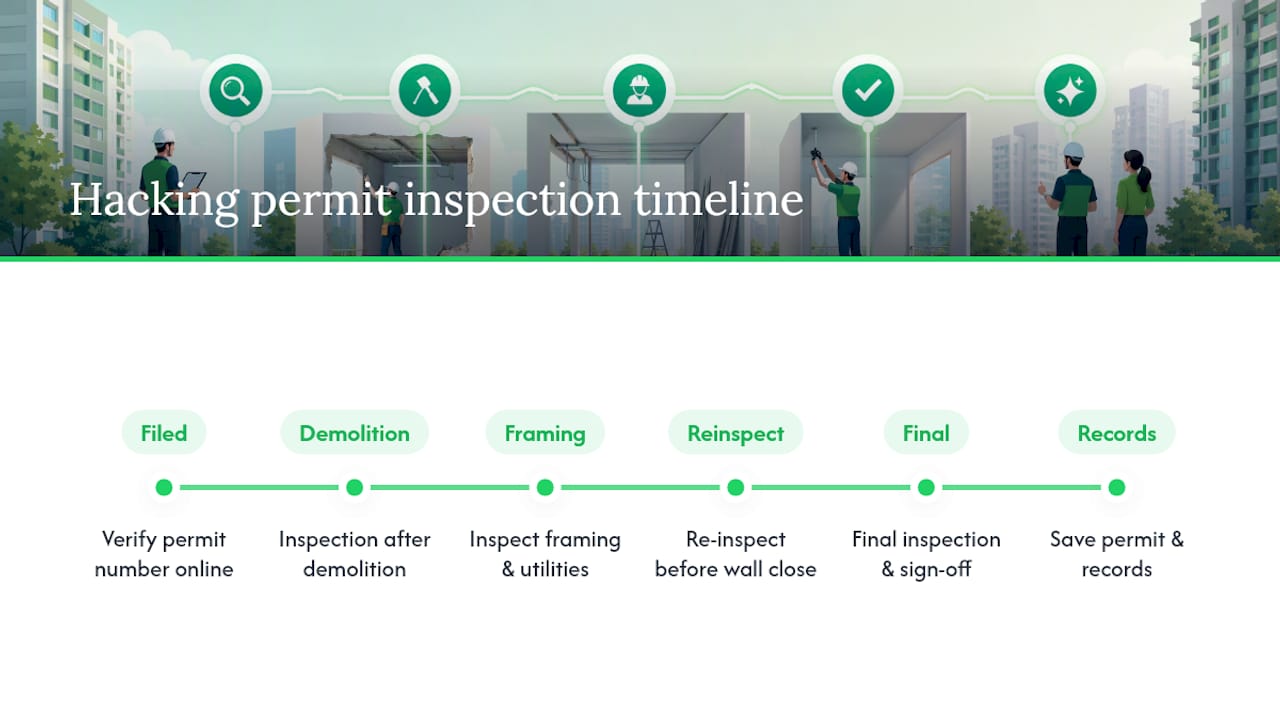
Keep a simple project folder, physical or digital, with the permit number, each inspection date, and the inspector's sign-off. This becomes essential documentation if you ever sell the home, since buyers' agents and title companies routinely check for unpermitted structural work.
What Regulations Govern Hacking and Demolition Work?
Regulations affecting interior hacking work stack up from a few different directions, and a competent contractor navigates all of them without you needing a law degree. Structural changes, meaning anything touching a load-bearing wall, almost always trigger a permit requirement and often require a structural engineer's review before work starts.
Interior demolition that affects electrical, plumbing, HVAC, or fire-rated wall assemblies crosses into permit territory even when no walls come down entirely. That includes removing a fire-rated door between a garage and living space, or capping plumbing lines during a bathroom gut. Local building codes vary by municipality on exactly where these thresholds sit, which is another reason a contractor with local project history is worth more than one quoting from a generic template.
Environmental rules layer on top of structural codes. The EPA's lead-based paint regulations apply to any pre-1978 home undergoing renovation or demolition, requiring certified testing and, if lead is found, specific containment and cleanup procedures. Asbestos rules vary more by state but generally require testing before disturbing older flooring, popcorn ceilings, or insulation.
One distinction worth understanding: soft demolition (removing non-structural elements like cabinetry or flooring) carries fewer regulatory hurdles than hard demolition involving structural walls or hazardous-material abatement. Bidders sometimes blur this line to win a lower quote, then discover mid-project that the scope actually requires permits they did not budget for. Nail down the classification in writing before signing.
What Happens After the Permit Is Approved?
Permit approval is the starting gun, not the finish line. Once the permit is issued, the actual inspection sequence begins, and this is where projects either stay on schedule or stall for weeks.
The first inspection hold point typically comes right after demolition, before any new framing, electrical, or plumbing work covers up what the inspector needs to see. Your contractor should schedule this proactively rather than waiting for you to ask. A failed inspection at this stage usually means exposed work still needs correction, which your contractor should absorb as part of their original quote, not bill you extra for.
Subsequent inspections follow as the project moves into reinstatement, particularly if electrical or plumbing lines were touched during hacking. Each inspection generates a sign-off that becomes part of your permanent property record. Coordinating these hold points is standard practice for experienced demolition contractors, and a contractor who treats scheduling as an afterthought is one you will end up chasing.
Final clearance documentation, sometimes called a certificate of completion or final inspection sign-off, is what confirms the permitted work closed out correctly. Get a physical or digital copy directly from your contractor, and separately confirm it appears in your municipality's permit portal. Do not release final payment until you have this document in hand. It is your proof, years from now, that the hacking work in your home was done legally and safely.
Why a Contractor-Led Approach Actually Protects You
The real value of hiring a contractor who owns the permit process isn't paperwork convenience. It's that someone with professional liability on the line is watching the inspection hold points you would otherwise miss. Homeowners who try to self-manage permits on structural work usually discover the gaps only when something goes wrong.
Require written permit numbers and inspection sign-offs as your proof of completion, every time, no exceptions. A contractor like Honest Builders that builds this into its standard process, rather than treating it as a favor, is the kind worth hiring.
Get a Written Scope and Permit Confirmation From Honest Builders
Honest Builders handles the parts of hacking work that homeowners can't easily verify themselves: pulling permits, screening for lead and other hazards, coordinating inspections, and managing demolition crews who know the difference between a load-bearing wall and a partition.

Every project starts with a written scope that spells out permit responsibility, a milestone payment schedule tied to inspection sign-offs, and no hidden charges added midway through the job. That structure alone is what most renovation disputes trace back to missing. Before hacking starts on your flat, ask Honest Builders for references and permit numbers from comparable jobs, and request that inspection sign-offs be a written condition of your final payment.
Ready to see it in writing? Request a quote from Honest Builders and get a scoped estimate with permit-handling terms spelled out before any wall comes down.
Frequently Asked Questions
Does a hacking contractor need to pull the permit, or can I do it myself? Most professional contractors handle permit filing as part of their standard service, since the application typically requires proof of the contractor's license. You can technically file it yourself in some jurisdictions, but you would still need a licensed party to perform structural work.
How do I know if my HDB-style flat renovation needs a permit at all? Any work touching load-bearing walls, electrical, plumbing, HVAC, or fire-rated assemblies generally requires a permit. Cosmetic changes like painting or replacing cabinetry usually do not.
What should I do if my contractor refuses to show a permit number? Treat it as a serious red flag and pause the project. Confirm directly with your municipal building portal whether any permit exists for your address before allowing further work.
Is lead paint testing required for every renovation? It is generally required for homes built before 1978 under EPA regulations. Newer construction typically does not carry the same testing requirement, though local rules can vary.
How much should I expect to pay in permit fees for hacking work? Permit fees for mid-size remodel work often range from $500 to $2,000 in many U.S. municipalities, though the exact figure depends on your local jurisdiction and project scope.
Sources
- Lead-based paint laws and regulations | US EPA
- What Is A Contract? | California Contractors State License Board (CSLB)
- Home-remodel-ideas