
Hacking in renovation is the demolition or removal of existing finishes and non-structural elements — tiles, walls, flooring, built-ins — to clear the way for new layouts or finishes. It is typically the first major stage of any significant renovation, and what happens during those first few days sets the pace and cost for everything that follows.
Before the first hammer swings, here is what you need to know:
- Expect real disruption. Hacking is loud, dusty, and messy. Plan for it.
- Permits may be required. Removing walls or altering structural elements almost always needs approval from your local building authority.
- Hazards can surface. Older homes may hide asbestos, lead paint, or mold behind walls and under tiles.
- Budget for surprises. Resale properties in particular tend to reveal hidden problems once finishes come off.
- Confirm scope in writing. Make sure your contractor's quote spells out exactly what is being hacked, who handles debris, and who pulls permits.
Table of Contents
- What exactly does "hacking" cover in a renovation?
- How the hacking process actually works, step by step
- Safety and hazardous materials: what homeowners must require
- How long hacking takes and what drives the cost
- When hacking is not the right choice
- Questions to ask contractors and red flags to watch for
- Dismantling versus hacking: why the difference matters
- Key Takeaways
- The part most homeowners get wrong
- Useful sources and further reading
- Honestbuilders handles the hard part so you don't have to
What exactly does "hacking" cover in a renovation?
Hacking refers to the forceful removal of interior finishes and non-structural elements to prepare a space for new work. Most homeowners encounter the term when reading a contractor quote and wondering why there is a separate line item for it.
Tasks that count as hacking:
- Removing floor or wall tiles (ceramic, porcelain, stone)
- Breaking down non-load-bearing walls or partitions
- Stripping plaster or cement screed from floors and walls
- Gutting bathrooms or kitchens down to the bare structure
- Removing built-in cabinetry that is bonded to walls or floors
- Pulling up old floor coverings (parquet, vinyl bonded to screed)
Tasks that are generally not hacking:
- Repainting walls or ceilings
- Installing overlay flooring over existing tiles
- Swapping out light fixtures or faucets
- Minor carpentry adjustments that do not involve demolition
The term also has a narrower technical meaning in plastering trades: roughening a surface to create a mechanical key so new plaster bonds properly. That is a different operation from the full demolition most homeowners mean when they use the word.
According to Megafurniture's renovation glossary, hacking covers the removal of tiles, walls, flooring, and built-in structures, and understanding the term directly affects how you read a quote and anticipate approval requirements.
Pro Tip: When reviewing a contractor quote, look for line items labeled "hacking," "debris removal," and "haulage" separately. If they are bundled into one vague number, ask for a breakdown. Haulage means bringing materials in; debris removal means getting waste out. Both cost money and both affect your timeline.
How the hacking process actually works, step by step
Hacking is typically the first major stage of a renovation, and its sequencing matters. Rush it or skip steps, and you pay for it later.
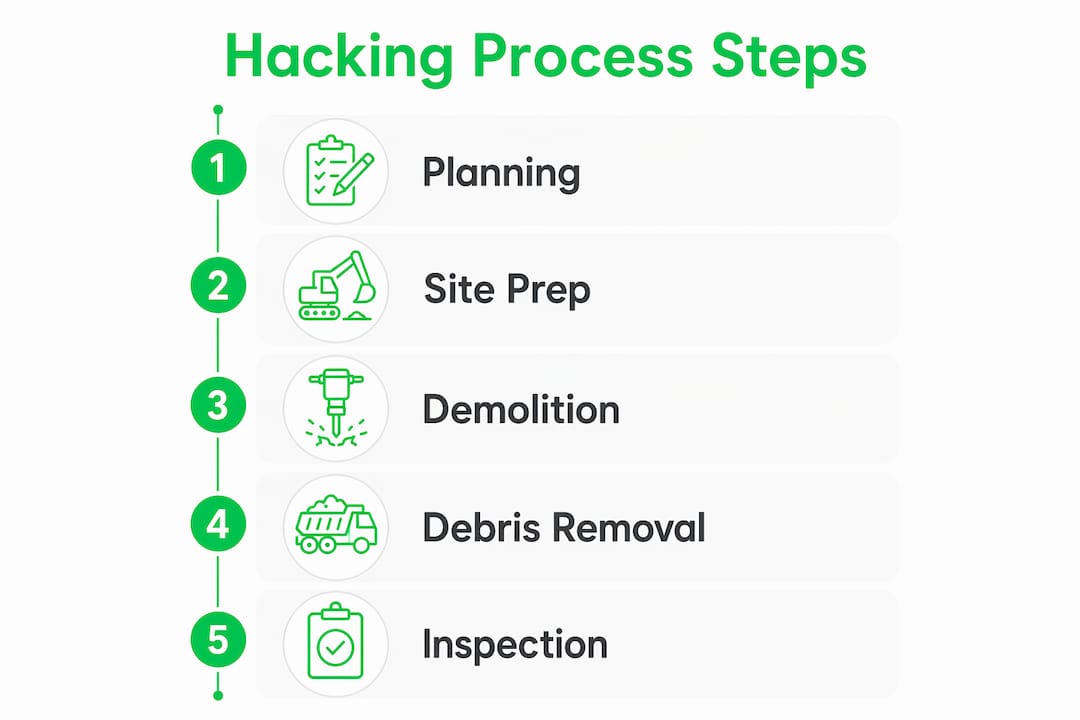
Planning and scope definition
Start with a site survey to confirm which walls are load-bearing, where utilities run, and what finishes are being removed. Your contractor or designer should produce a demolition plan before any work begins.
Permits and notifications
This is where many homeowners get caught off guard. Housing authorities regulate which walls and finishes can be altered and when permits are required. For example, HDB's renovation guidelines require homeowners to use contractors from their approved directory and to obtain permits before structural or certain non-structural works begin. U.S. homeowners face similar requirements through local building departments, and the rules vary by city and state.
Contractor permit checklist:
- Confirm who applies for the permit (owner or contractor)
- Get the permit number in writing before work starts
- Verify the permit covers demolition, not just new construction
- Check whether a structural engineer's sign-off is required for wall removal
- Confirm notification requirements for neighbors or building management
Site preparation
Before demolition begins, the site needs protection. This means dust barriers between work zones and living areas, protective sheeting over floors in transit paths, lift bookings for debris removal in multi-unit buildings, and isolation of electrical circuits and water supply in the work zone. Skipping this step is how you end up with dust in your HVAC system and a complaint from the neighbor two floors down.
The demolition work itself
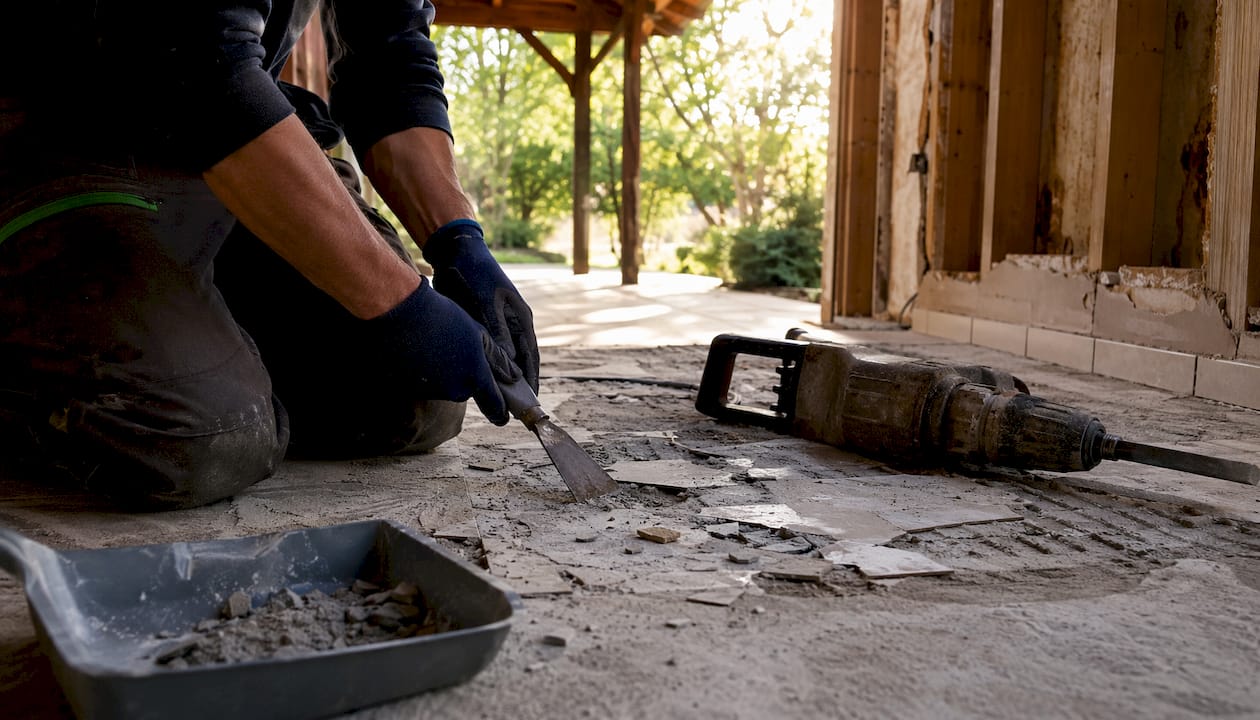
Tile removal uses chisels and angle grinders. Masonry walls come down with jackhammers or rotary hammers. Drywall partitions are cut and pulled. The sequence typically runs from top to bottom and from wet areas outward, so water damage does not compound as work progresses. Noise and dust are unavoidable; the question is whether they are contained.
Cleanup and debris removal
Haulage and debris removal are separate logistical phases. Failing to plan for repeated debris clearance in multi-unit housing often stalls projects and generates neighbor complaints. Debris from a single bathroom gut can fill several large bags or a small dumpster. In apartment buildings, lift access is usually restricted to certain hours, which means debris removal needs to be scheduled, not improvised.
Example timeline: small condo wall removal
- Day 0: Site survey, permit confirmed, utilities isolated
- Day 1: Protective sheeting installed, dust barriers up
- Days 2–3: Wall hacking and tile removal
- Day 4: Debris cleared, site inspected for hidden issues
- Days 5–7: Patching, leveling, or waterproofing if surprises found
Safety and hazardous materials: what homeowners must require
Hacking exposes whatever was hidden behind walls and under floors for decades. In older homes, that can mean serious health hazards.
Common hazards during demolition:
- Asbestos in old floor adhesives, ceiling tiles, or textured plaster (common in homes built before the 1980s)
- Lead paint on walls, trim, or window frames
- Mold behind tiles or inside wall cavities, especially in bathrooms
- Hidden electrical wiring or plumbing that is not on any drawing
- Structural surprises, such as a wall that turns out to be load-bearing
Testing and verification:
Before hacking begins in any home built before 1980, test for asbestos and lead paint. In the U.S., the EPA's Renovation, Repair, and Painting (RRP) Rule requires contractors working in pre-1978 homes to be certified and to follow lead-safe work practices. The cost of testing is small compared to the cost of remediation after contaminated dust has spread through the house.
Waste handling:
Hazardous materials cannot go into a regular dumpster. Asbestos-containing materials require licensed abatement contractors and disposal at approved facilities. Lead paint debris has its own handling requirements. Your local municipality's hazardous waste program sets the rules; check with your city or county before assuming standard disposal is fine.
Site safety behaviors to enforce:
- Limit your own visits to the site during active hacking
- Require workers to wear appropriate PPE (respirators, eye protection, gloves)
- Confirm dust barriers are sealed before demolition starts
- Ask for a daily site report rather than walking through mid-work
- Verify the lift or common areas are protected if you are in a multi-unit building
Both Qanvast and VIA Media recommend limiting homeowner visits during the hacking phase to reduce risk and keep workers focused. It is practical advice that most homeowners ignore until something goes wrong.
Pro Tip: Require your contractor to include an explicit hazardous-materials clause in the contract, along with a written waste-management plan. If they push back on either, that is a red flag worth taking seriously.
Safety note: Asbestos and lead paint regulations in the U.S. are enforced at the federal and state level. This article is general information. Confirm current requirements with your local building department or a licensed abatement professional before work begins.
How long hacking takes and what drives the cost
Hacking costs are shaped by a handful of variables, and the surprises that push budgets higher are almost always the same ones.
How contractors price hacking:
- Per square foot of surface area (common for tile removal)
- Per day of labor for wall demolition
- Lump sum covering demolition plus debris removal and haulage
- Contingency line items for unknown conditions
Key cost drivers:
- Wall type: masonry walls take significantly longer and cost more to remove than drywall partitions
- Tile removal difficulty: large-format tiles bonded with thick adhesive are harder to remove than smaller, older tiles
- Access and lift constraints: in apartment buildings, restricted lift hours slow debris removal and add labor time
- Hazardous-material abatement: asbestos or lead remediation adds cost and time that cannot be predicted until testing is done
- Hidden repairs: resale properties frequently hide water leaks, mold, and uneven floors that trigger additional waterproofing or leveling works once finishes are removed
Rough time ranges by job size:
- Small (single bathroom or one wall): 1–3 days of hacking, plus 1–2 days for debris clearance
- Medium (full kitchen and bathroom gut): 3–5 days of hacking
- Large (whole-unit strip-out): 1–2 weeks, depending on access and hazardous-material findings
For a full renovation timeline, hacking is usually the shortest phase but the one most likely to reveal problems that extend the overall schedule.
Pro Tip: Build a 15–20% contingency into your hacking budget specifically for hidden conditions. Cutting a wall halfway is often as complex as removing it entirely, since partial hacks require precision to avoid damaging the remaining structure. If your contractor quotes a half-wall removal at a steep discount versus a full removal, ask why.

When hacking is not the right choice
Not every renovation needs demolition. Sometimes a less invasive approach delivers the same result at lower cost and with far less disruption.
Alternatives worth considering:
- Overlay flooring: Vinyl plank or engineered wood installed over existing tiles avoids tile hacking entirely. Faster, cheaper, and no debris. The trade-off is a slightly raised floor height.
- Reglazing or resurfacing: Bathtubs, tiles, and countertops can be reglazed for a fraction of the cost of replacement. Works well when the substrate is sound.
- Careful dismantling for reuse: Cabinets and built-ins that are screwed rather than bonded can often be removed intact and reused or sold. This is dismantling, not hacking.
- Cosmetic uplift: New paint, hardware, lighting, and soft furnishings can transform a space without touching a single tile.
For lower-impact updates, refreshing your space without full demolition is a legitimate strategy that many homeowners overlook when they get caught up in a full renovation mindset.
When to avoid hacking:
- Tight budgets with no contingency room
- Heritage or protected properties with restrictions on structural changes
- When only a cosmetic update is needed and the substrate is in good condition
- Short timelines that cannot absorb the disruption
| Factor | Hacking | Dismantling | Overlay/Resurface |
|---|---|---|---|
| Messiness | High | Low–Medium | Low |
| Time | Moderate | Moderate | Fast |
| Cost | Higher | Moderate | Lower |
| Reuse potential | Low | High | N/A |
| Permit likelihood | Higher | Lower | Rare |
Questions to ask contractors and red flags to watch for
A contractor who handles hacking well will have clear answers to all of these. One who hedges or deflects on any of them deserves a second look.
Essential questions:
- Have you done similar projects in this building type or age range?
- Who applies for the demolition permit, and can I see it before work starts?
- What is your waste-management plan, and where does debris go?
- Do you carry general liability insurance? Can I see the certificate?
- How do you handle hidden hazards like asbestos or mold if found?
- What is the change-order process if scope expands?
- What milestones will you hit each day, and how will you communicate progress?
Red flags:
- Vague scope with no itemized breakdown of what is being hacked
- No written debris removal or haulage plan
- Requests for a large cash-only deposit upfront
- No proof of insurance or unwillingness to provide references
- Dismissing permit requirements as "not necessary for this job"
Trust signals to look for:
- Itemized quote with separate line items for hacking, debris removal, and haulage
- Written mention of hazardous-material testing or a protocol for handling surprises
- A documented debris removal schedule tied to lift access hours
- A written defect liability period or workmanship warranty
For a broader look at what a renovation checklist should cover before work begins, the pre-hacking preparation steps are the same regardless of property type.
Printable contractor checklist:
- Itemized quote received
- Permit confirmed (number in writing)
- Insurance certificate on file
- Waste-management plan in contract
- Hazardous-materials clause included
- Milestone schedule agreed
- Change-order process documented
- References checked
Dismantling versus hacking: why the difference matters
Most homeowners use "hacking" and "dismantling" interchangeably. Contractors do not, and the distinction affects both cost and what you can salvage.
Dismantling is careful, methodical removal for reuse. Hacking is faster, more forceful demolition where preservation is not the goal. Both have their place on the same job site.
When to choose dismantling:
- Cabinets or wardrobes that are screwed to walls and can be resold or reused
- Doors, frames, and hardware in good condition
- Fixtures that can be donated or repurposed
- Any element where the substrate beneath needs to stay intact
When hacking is the right call:
- Tiles bonded with thick adhesive that cannot be removed without breaking
- Masonry walls being fully removed
- Old plaster or screed that needs to come off entirely for new waterproofing
Combining both methods on the same project reduces waste and can lower overall costs. A carpentry guide can help you identify which built-ins are worth salvaging before demolition begins.
Pro Tip: Walk through the space with your contractor before hacking starts and flag every item you want dismantled rather than demolished. Once the jackhammer is running, that conversation is over.
Fewer homeowner visits during this phase also speeds progress. Workers make faster decisions and fewer errors when they are not stopping to explain each step. Schedule one check-in per day at a set time rather than dropping by whenever.
Key Takeaways
Hacking is the demolition phase that sets the foundation for every trade that follows; getting the permits, safety checks, and contractor scope right before day one prevents the majority of budget blowouts.
| Point | Details |
|---|---|
| Hacking defined | Forceful removal of tiles, walls, flooring, and built-ins to prepare for new renovation work. |
| Permits first | Check local building authority requirements before any wall or tile removal begins. |
| Budget for surprises | Resale properties commonly hide water damage, mold, and uneven floors; build in a contingency for unexpected costs. |
| Require a waste plan | A written debris removal and haulage plan in the contract prevents delays and neighbor complaints. |
| Honestbuilders | Honestbuilders handles hacking, tiling, carpentry, and full residential renovation across HDB, condo, and landed properties in Singapore. |
The part most homeowners get wrong
Most renovation guides focus on the exciting parts: the new kitchen layout, the tile selection, the paint colors. Hacking gets a paragraph, maybe two. That is backwards.
The hacking phase is where the real risk lives. Hidden water damage, asbestos in old adhesives, a wall that turns out to be load-bearing when the drawings said otherwise. These are not rare edge cases. They are common enough that any experienced contractor prices in a contingency without being asked.
What I see homeowners consistently underestimate is the compounding effect of a poorly scoped hacking job. A contractor who does not itemize debris removal separately is not just being vague about costs. They are signaling that they have not thought through the logistics. In a multi-unit building, unplanned debris clearance means missed lift windows, which means delayed trades, which means a renovation that runs two weeks longer than quoted.
The single most useful thing you can do before hacking starts is require a written scope that separates hacking, dismantling, debris removal, and hazardous-material handling into distinct line items. Not because you need to audit every hour, but because a contractor who can write that document clearly has actually thought the job through.
Useful sources and further reading
These resources cover permit requirements, renovation sequencing, and practical homeowner guidance. Local rules vary; always verify current requirements with your local building department or housing authority.
- HDB Renovation Guidelines — Official permit rules, contractor directory requirements, and technical guidance for HDB flat renovations in Singapore.
- HDB Building Works Guidelines — Detailed breakdown of which building works require permits and which are prohibited.
- Qanvast: Complete Guide to Hacking — Practical homeowner explainer covering permits, common surprises, haulage, and debris management.
- VIA Media: Hacking and Dismantling — Explains the distinction between dismantling and hacking and when to use each method.
- Megafurniture Renovation Glossary — Plain-language definitions of renovation terms, including hacking, to help homeowners read quotes accurately.
- Honestbuilders.sg — Renovation and handyman services covering hacking, tiling, carpentry, electrical, and full residential projects in Singapore.
- U.S. EPA Renovation, Repair, and Painting Rule — Federal requirements for lead-safe work practices in pre-1978 homes; search "EPA RRP Rule" at epa.gov for current guidance.
- Your local building department — The definitive source for demolition permit requirements, structural engineer sign-off thresholds, and hazardous-material disposal rules in your jurisdiction.
Honestbuilders handles the hard part so you don't have to

Hacking is the phase that separates a well-run renovation from one that stalls, blows the budget, or leaves you dealing with a contractor who "didn't know" about the mold behind the tiles. Honestbuilders takes that risk off your plate. As Singapore's renovation and handyman specialists, the team handles the full scope: hacking, tiling, carpentry, electrical, plumbing, painting, and space planning across HDB, condo, landed, and commercial properties.
No hidden charges. No vague quotes. Every project comes with a clear scope, a written debris plan, and accountability from start to finish. If you are planning a renovation and want to know exactly what the hacking phase will involve for your specific property, get a free quote via WhatsApp at +65 9447 9696. No obligation, no runaround.