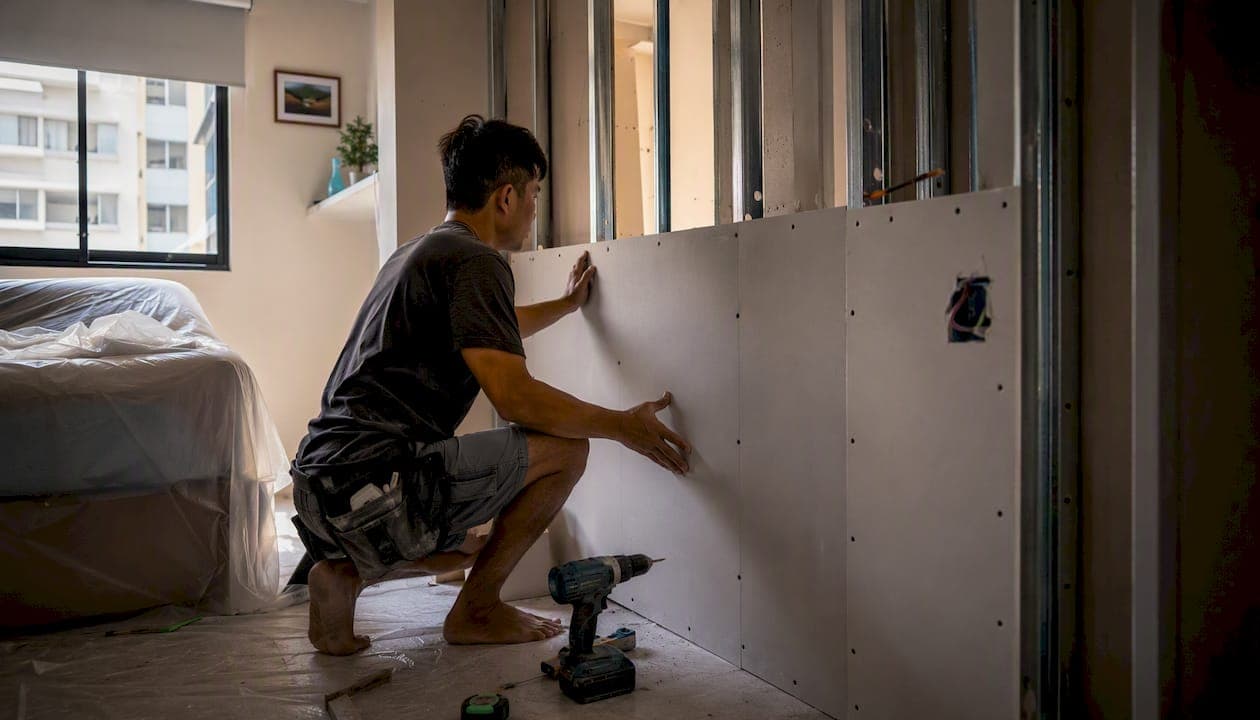
Most internal partition installs in Singapore run at rates varying by material, finish, and whether acoustic or fire-rated specs are required; understanding family unit sizes in condos explained for families can help with planning space and partition needs. A standard gypsum (drywall) wall sits at the lower end; frameless glass or operable folding systems push toward the top. All figures in this guide are in Singapore dollars (SGD), and every number assumes a site visit has confirmed access, ceiling height, and finish spec.
Here is a quick anchor to calibrate your budget before reading further:
- Gypsum/drywall partition: Typically at a lower rate per sq m
- Modular/demountable panel system: Generally costs more per sq m than gypsum
- Glass partition (framed): Priced higher than modular systems
- Glass partition (frameless): Usually at the higher cost end per sq m
- Acoustic or fire-rated upgrade: Adds a noticeable premium per sq m
- Operable/folding partition: Among the more expensive per sq m options
Sample calculation: A 6m-wide by 2.7m-high gypsum partition covers 16.2 sq m. At a mid-range rate of SGD 110 per sq m, materials and labor together come to roughly SGD 1,782 before add-ons like door frames, electrical cutouts, or skirting. A 3m × 2.7m framed glass panel (8.1 sq m) at SGD 230 per sq m lands around SGD 1,863 installed. These are planning figures only. The Building and Construction Authority (BCA) sets structural and fire-safety standards that affect which materials are permitted in HDB and commercial builds, so your final quote must reflect those requirements.
Key Takeaways
Partition wall costs in Singapore vary widely depending on material, finish, acoustic rating, and site access, making an onsite measure the only reliable path to a final number.
| Point | Details |
|---|---|
| Budget anchor | Gypsum walls run SGD 80–150/sq m; frameless glass reaches SGD 400+/sq m. |
| Biggest cost driver | Material type and acoustic/fire rating move the price more than finish quality. |
| Access adds cost | Condo elevator windows and HDB corridor rules can push labor rates higher. |
| Get itemized quotes | Separate materials, labor, delivery, and extras so bids are truly comparable. |
| Honestbuilders | Offers free onsite measures, itemized quotes, and workmanship warranty across HDB, condo, and commercial projects. |
Table of Contents
- What types of partition walls are common in Singapore?
- What drives partition wall quotes up or down?
- How much do partition walls actually cost in Singapore?
- What does installation involve, and when do you need permits?
- How do you get an accurate partition wall quote?
- How can you lower the cost without cutting corners?
- How Honestbuilders produces on-site estimates
- What most clients miss when budgeting for partitions
- Honestbuilders handles partition installs island-wide
- Sources
What types of partition walls are common in Singapore?
Choosing the right partition type before you call a contractor saves you from comparing quotes that aren't measuring the same thing.
Gypsum/drywall partitions are the most common and affordable option. A metal-stud frame holds gypsum board on each face, the cavity is left open or filled with insulation, and the surface is skimmed and painted. They suit HDB bedroom dividers, home office walls, and retail back-of-house areas. Metal-stud gypsum systems carry lower baseline per-sq-ft pricing, but fire-rated assemblies and higher STC (Sound Transmission Class) ratings add meaningfully to both materials and labor.
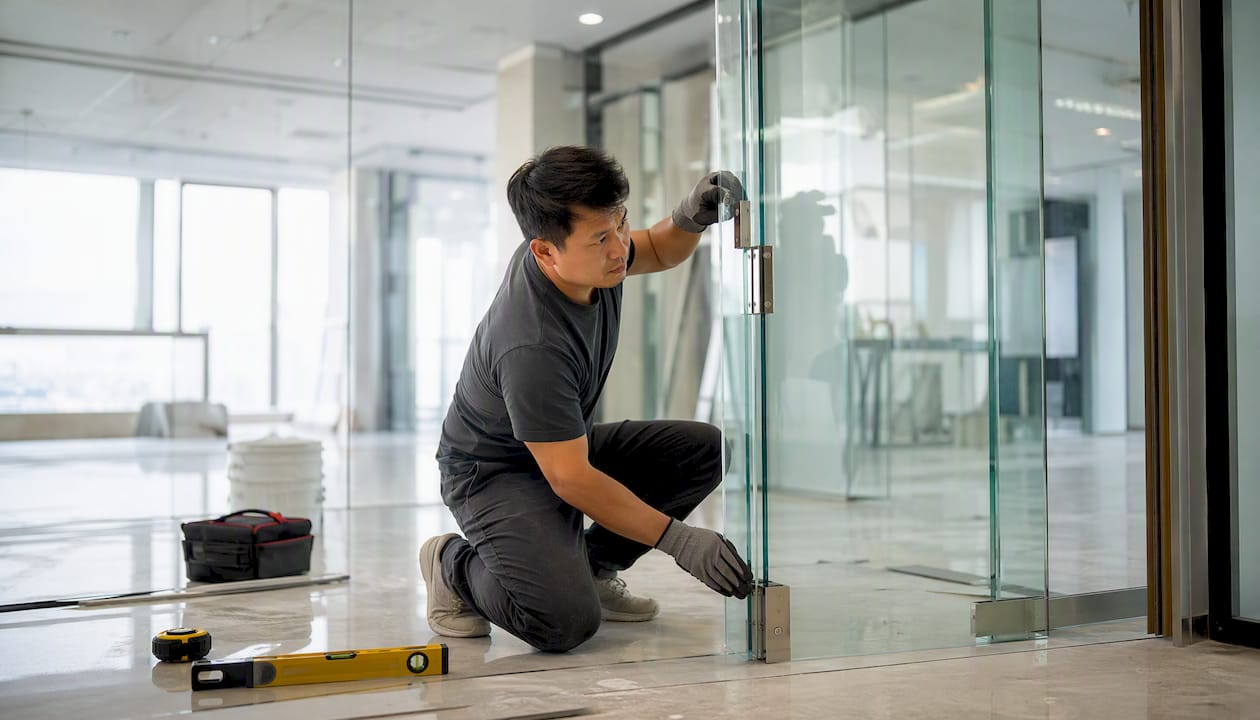
Glass partitions work well for offices, meeting rooms, and retail fronts where you want natural light to pass through. Framed systems (aluminum or steel frame around the glass) cost less than frameless; single glazing costs less than double. Glass thickness, framing type, and single vs. double glazing are the primary cost drivers, and installation often requires specialist equipment, which adds to labor. Frosted or manifestation film on clear glass is a common finish that adds privacy without a major price jump.
Modular/demountable systems use prefabricated panels that bolt together and can be relocated without hacking. They suit commercial tenants who may need to reconfigure or reinstate a space at lease end. Laminate, fabric, or glass infill panels are available, and the system can accept electrical and data raceways within the panel depth.
Acoustic partitions are gypsum or modular systems with dense insulation cores, acoustic seals at the perimeter, and sometimes double-leaf construction. They are specified for music rooms, boardrooms, and medical consultation rooms. Fire-resistant gypsum panels carry a premium over standard board and must meet applicable fire ratings for the intended use; in Singapore, commercial fit-outs often require BCA-compliant fire-rated assemblies between tenancies.
Operable/folding partitions run on overhead tracks and fold away to open a space. Hotels, function rooms, and larger HDB living areas use them to create flexible layouts. Operable systems cost more than framed-panel alternatives because of the track, hardware, and acoustic sealing requirements, and they need a structural ceiling capable of carrying the track load.
What drives partition wall quotes up or down?
Understanding the line items in a contractor's quote lets you compare bids on equal footing rather than just picking the lowest number.
Primary cost drivers
- Material type and grade — glass vs. gypsum vs. modular is the single biggest determinant of installed cost. Acoustic cores and fire-rated assemblies move the marginal price more than almost any other upgrade.
- Wall area (sq m) — larger walls spread fixed mobilization costs across more area, so the per-sq-m rate often drops on bigger jobs.
- Ceiling height — floor-to-ceiling heights above 2.7m require taller panels, more framing, and sometimes scaffolding or elevated work platforms.
- Finish level — painted gypsum is the baseline; laminate, veneer, or integrated glass infills each add cost.
- Acoustic or fire rating — STC upgrades and fire-rated assemblies add materials and labor; always ask which rating is required before accepting a quote.
Site and access drivers
- Floor level and lift access — materials delivered to a high floor in a condo with restricted elevator booking windows add labor time.
- HDB and MCST rules — reinstatement and access constraints in HDB corridors and condo common areas commonly push small jobs into higher per-unit labor rates; plan for this when budgeting.
- Protected common areas — any work affecting fire-escape corridors or structural elements needs BCA or HDB approval before a contractor can start.
Fixed extras that often appear as separate line items
- Door frames, hinges, and locksets
- Electrical or data cutouts and conduit routing
- Skirting boards and floor thresholds
- Delivery, hoisting, and waste removal
Pro Tip: A single acoustic upgrade — moving from a standard gypsum wall to a high-STC assembly with perimeter seals — often costs more than doubling the finish quality from painted to laminated. Decide on acoustic performance first, then choose your finish.
How much do partition walls actually cost in Singapore?
The table below gives realistic installed ranges per sq m for each partition type, along with typical STC expectations and maintenance notes. These are mid-market Singapore figures; site-specific factors will move your actual quote.
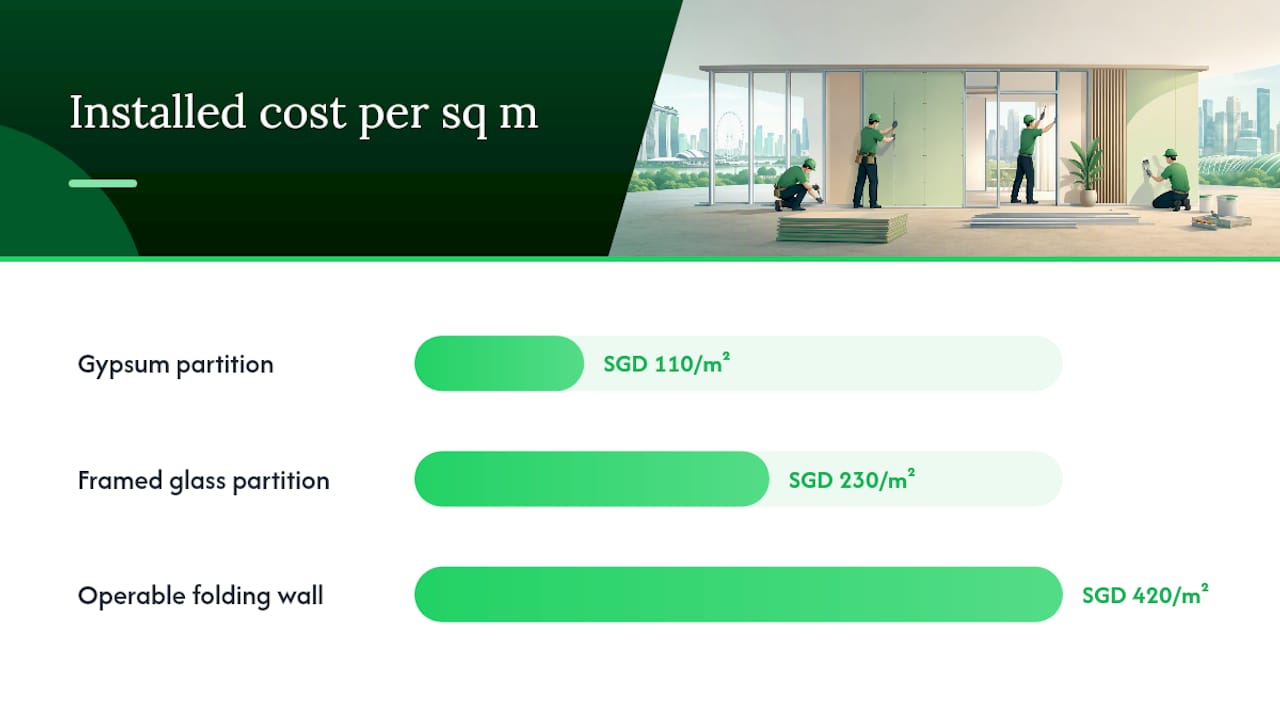
Office partition costs vary by panel type, materials, and installation scope, and full-room installs typically bundle framing, finishes, and accessories for efficiency, which is why per-sq-m rates on larger projects often undercut single-panel additions.
Sample job math:
- 3m × 2.7m framed glass partition: 8.1 sq m × SGD 230 = SGD 1,863 (excludes door hardware and electrical)
- 6m × 2.7m gypsum partition: 16.2 sq m × SGD 110 = SGD 1,782 (excludes skirting and painting touch-up)
- 4m × 2.7m operable folding wall: 10.8 sq m × SGD 420 = SGD 4,536 (track, hardware, and acoustic seals included in mid-range estimate)
These figures are planning anchors. A site visit changes the number every time — ceiling height, substrate condition, and access constraints all affect the final quote.
What does installation involve, and when do you need permits?
A typical partition install moves through five stages: site measure and mark-out, material fabrication or supply, installation, finishing (plastering, painting, or glazing), and handover with a walkthrough. For a standard gypsum wall in an HDB flat, that sequence usually takes two to four days. Glass or operable systems run longer because of fabrication lead times, often one to three weeks from order to install.
When approvals are needed:
- HDB flats: Hacking structural walls requires HDB approval and a licensed contractor. Non-structural partitions generally don't need a permit, but check with HDB if the work affects fire-escape routes or common corridors. Tenants must also confirm reinstatement obligations with their landlord before starting. For a full breakdown of what's permitted, the HDB renovation guide for resale flats covers the key rules.
- Condos: MCST rules vary by development. Most require written approval for any works that affect common property, and many restrict working hours to weekdays between 9 AM and 5 PM. The condo repair guide for Singapore homeowners outlines typical MCST requirements.
- Commercial fit-outs: BCA-compliant fire-rated assemblies are often mandatory between tenancies. Check with your building management and a licensed contractor before specifying materials. The commercial renovation compliance checklist is a useful starting point.
Pro Tip: *Book your contractor and material supplier with at least a one-week buffer beyond your target completion date.
How do you get an accurate partition wall quote?
Contractors price what they can see. The more specific your brief, the closer the first quote will be to the final invoice.
What to prepare before calling
- Measured dimensions: wall length, ceiling height, and any openings (doors, windows, pass-throughs)
- Desired partition type and finish (painted gypsum, laminate, clear or frosted glass)
- Acoustic or fire-rating requirements, if known
- Door and threshold needs, including hardware preferences
- Electrical or data points that need to pass through the wall
- Target completion date and any access constraints (condo hours, HDB corridor rules)
What a good itemized quote includes
- Materials broken out by type and quantity (board, framing, glass, insulation)
- Labor as a separate line, ideally with a day-rate or sq-m rate shown
- Delivery, hoisting, and waste removal
- Any subcontracted work (glazing, electrical)
- Payment schedule tied to milestones
- Warranty terms and workmanship guarantee period
Questions to ask every contractor
- Are you licensed and insured for this type of work in Singapore?
- What is your workmanship warranty, and what does it cover?
- Does the quote include cleanup and waste removal?
- Who sources the materials, and can I see the product spec sheets?
- Have you handled HDB reinstatement or MCST approval processes before?
Red flags: a single all-in figure with no itemization, a contractor who has never worked in your building type, or a quote that arrives without a site visit. Suppliers quoting from outside Singapore may not account for local reinstatement rules or BCA requirements.
How can you lower the cost without cutting corners?
There is real money to save on a partition project if you target the right variables.
- Choose painted gypsum over laminate where the wall won't take heavy wear. The finish difference is aesthetic; the structural and acoustic performance is the same.
- Consolidate openings. Every door frame, electrical cutout, or service penetration is a separate labor charge. Grouping them on one wall reduces mobilization time.
- Reuse existing frames where the substrate is sound. A contractor can often skin an existing stud frame with new board rather than building from scratch.
- Bundle partition work with related trades. If you're already having carpentry or painting done, adding a partition in the same visit spreads the mobilization cost across more work.
- Consider modular systems for leased spaces. The higher upfront cost pays back if you relocate or reinstate, since demountable panels come out without hacking.
Pro Tip: Ask for an itemized quote and negotiate on material grade rather than labor rate. Cutting the labor rate pushes contractors toward faster, lower-quality work. Dropping one finish grade on a non-visible wall saves money without touching workmanship.
How Honestbuilders produces on-site estimates
An accurate quote starts with a physical visit. No floor plan or photo substitutes for a contractor standing in the space, measuring ceiling height, checking substrate condition, and noting access constraints.
On-site assessment checklist
- Measure wall length and ceiling height — confirm actual dimensions against any drawings provided
- Check substrate and floor condition — slab vs. raised floor, tile vs. screed, affects fixing method and cost
- Note all openings — doors, windows, service penetrations, and their positions
- Confirm finish and acoustic/fire spec — verify against BCA or HDB requirements for the property type
- Assess access — elevator booking windows, corridor width, working-hour restrictions
- List all extras — skirting, thresholds, electrical cutouts, delivery route
A sample Honestbuilders quote breakdown for a mid-range gypsum partition project looks like this:
- Materials (board, metal stud, insulation, fixings): SGD 600–900
- Labor (two-person crew, one day): SGD 400–600
- Delivery and waste removal: SGD 80–150
- Extras (door frame, skirting, one electrical cutout): SGD 200–400
- Total estimate: SGD 1,280–2,050 for a 16 sq m wall
Every Honestbuilders quote is itemized, so you can see exactly what you're paying for. The team is licensed and insured, and all partition work carries a workmanship warranty. Before booking, check out the renovation checklist for new HDB flats to make sure your project scope is complete.
What most clients miss when budgeting for partitions
The number clients most consistently underestimate is the cost of access. A partition job that takes one day in a landed property can take two in a condo with a 9 AM–5 PM elevator booking window and a 30-minute loading bay limit. That extra day is pure labor cost, and it shows up on the invoice as a surprise.
The second thing people miss is reinstatement. If you're a tenant or an HDB flat owner planning to sell, the partition you install today may need to come out later. Demountable systems cost more upfront but save on reinstatement. Hacked gypsum walls cost less to install but more to remove cleanly. An onsite measure is the only way to finalize a reliable quote, and it's also the right moment to ask your contractor about reinstatement obligations before committing to a material.
Honestbuilders handles partition installs island-wide
Honestbuilders covers gypsum, glass, and modular partition installs across HDB flats, condos, landed homes, and commercial spaces in Singapore. Every project starts with a free onsite measure, an itemized quote that separates materials from labor, and a clear timeline. There are no hidden charges and no vague all-in figures.

The team handles HDB reinstatement experience, MCST approval coordination, and BCA-compliant fire-rated assemblies for commercial fit-outs. Whether you need a single bedroom divider or a full office partition layout, Honestbuilders shows up, measures properly, and quotes honestly.
WhatsApp Honestbuilders at +65 9447 9696 or visit Honestbuilders to book your free onsite quote today.
Sources
- Metal stud partition prices: cost breakdown and typical ranges
- Fire-resistant gypsum panels | Gypsum Association
All prices are indicative planning figures in SGD. A licensed contractor's onsite assessment is required before any final quote can be confirmed.