
A renovation progress payment is a partial payment released to your contractor when a defined project milestone is verified as complete. This payment structure, formally called a milestone payment schedule, protects both homeowners and contractors by tying cash flow to real, measurable work. Understanding progress payments before you sign any renovation contract is the single most effective way to avoid disputes, overpayment, and stalled projects. This article covers how these payments are structured, what Singapore law requires, and how to write milestones that actually hold up.
What is a renovation progress payment and why does it matter?
A progress payment is a partial payment made based on milestones or the value of work completed, as defined in your contract. It is not a lump sum paid upfront, and it is not a time-based payment tied to the calendar. The payment is released only after a specific phase of work is verified.
This structure matters because it aligns financial incentives with actual progress. A contractor who has not yet been paid for the next phase has a direct reason to complete the current one correctly. For homeowners, it means you are never far ahead of the work with your money.

The renovation payment schedule is the document that maps each milestone to a payment amount and a timeline. Without one, you are relying on goodwill rather than contract terms. In Singapore, where renovation projects range from HDB flat upgrades to landed home overhauls, a clear payment schedule is a non-negotiable contract element.
How are progress payments structured in Singapore renovation contracts?
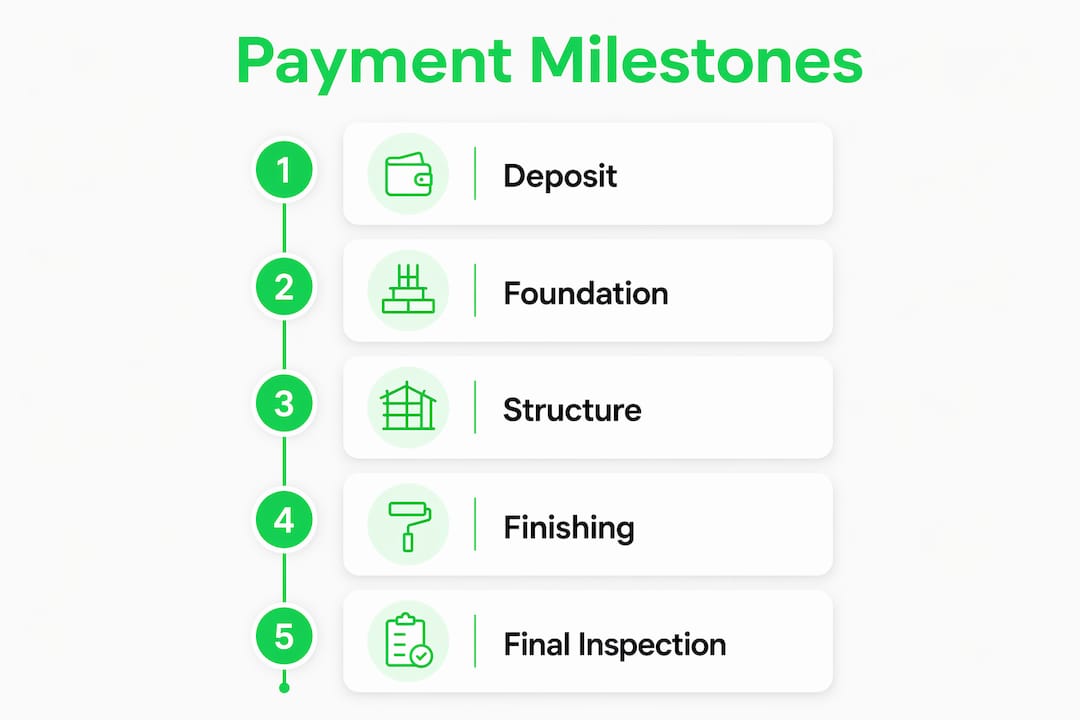
Renovation contracts in Singapore typically use a milestone-based structure with four to six payment tranches. A common split for a residential renovation looks like this:
- Deposit (10%) — Paid upon contract signing to confirm the engagement.
- Commencement (20–30%) — Released when hacking, demolition, or structural work begins and is verified.
- Rough-in completion (30%) — Triggered when electrical, plumbing, and tiling rough-ins pass inspection.
- Carpentry and fitting (20%) — Released when built-in carpentry and major fittings are installed.
- Practical completion (10–15%) — Paid when all works are done and a walkthrough confirms the punch list is clear.
- Retention release (5–10%) — Held back and released after a defect liability period, typically 30–90 days post-completion.
Retention of 5% to 10% withheld until final inspections serves as leverage to ensure defects are fixed before the project closes out. This is one of the most underused protections available to homeowners. Many skip it because the contractor pushes back, but retention is standard practice in the construction industry.
Payment timelines matter too. Each tranche should specify how many days after milestone verification the payment is due, typically 7–14 days. Objective, measurable milestones are what prevent disagreements over whether a phase is actually complete.
Pro Tip: Always require photographic evidence and a written sign-off before releasing any payment tranche. A photo of completed tiling is not proof of quality, but it is proof of completion and creates a paper trail if disputes arise later.
What Singapore laws protect renovation progress payments?
Singapore's Building and Construction Industry Security of Payment Act (BCISPA) is the primary legal framework governing payment rights in construction and renovation. BCISPA establishes payment claim procedures, valuation rules, and a fast adjudication process to enforce timely payments. It applies to most renovation contracts involving works on buildings in Singapore.
Key protections under BCISPA include:
- Right to progress payments. Contractors and subcontractors have a statutory right to submit payment claims at agreed intervals or upon milestone completion.
- Payment response obligation. Once a payment claim is submitted, the respondent must issue a payment response within the timeframe set by the contract or the Act.
- Adjudication as fast dispute resolution. If a payment dispute arises, either party can apply for adjudication. The adjudicator's determination is binding and enforceable, typically within weeks rather than months.
- Ban on pay-when-paid clauses. BCISPA limits the enforceability of clauses that make a subcontractor's payment contingent on the main contractor first receiving payment from the developer.
- Documentation requirements. Singapore's payment regulations require detailed, itemized claims and timely responses to support adjudication.
Compliance with claim timing is not optional. Improper timing of a payment claim can negate its validity in adjudication entirely. This means a contractor who submits a claim one day outside the contractual window may lose the right to enforce it through the statutory process. Homeowners benefit from understanding this because it also means your payment response must be issued on time to preserve your rights.
BCISPA provides a strong safety net, but it does not replace a well-written contract. The Act works best when the underlying contract already defines clear milestones and payment terms.
How do you define milestones that prevent payment disputes?
Clear milestones are the foundation of a dispute-free renovation payment schedule. Clear contract terms with verification steps prevent disagreements over whether a milestone has been achieved. Vague language is the most common source of payment disputes in residential renovations.
| Vague milestone wording | Precise milestone wording |
|---|---|
| "Tiling works substantially done" | "All floor and wall tiling in bathrooms 1 and 2 completed and grouted, passed homeowner walkthrough" |
| "Electrical works in progress" | "First-fix electrical rough-in complete, conduits laid, and passed HDB/BCA inspection" |
| "Carpentry mostly installed" | "All built-in wardrobes and kitchen cabinets installed, doors aligned, and hardware fitted" |
| "Painting complete" | "Two coats of paint applied to all rooms, touch-ups done, and homeowner sign-off obtained" |
Precise milestones do three things. They tell the contractor exactly what is required to trigger payment. They give you a clear checklist for verification. They give an adjudicator or court a concrete standard to measure against if a dispute goes formal.
Record-keeping is equally important. Detailed documentation backing each payment request, including invoices, receipts, and photos, reduces the risk of overpayment and supports invoice accuracy. Keep a folder for each tranche with dated photos, written sign-offs, and copies of any inspection certificates.
Pro Tip: Include a payment release condition in each milestone clause. For example: "Payment of $X,XXX is due within 7 days of homeowner written sign-off confirming milestone 3 is complete." This removes ambiguity about when the clock starts.
How do payment schedules differ across HDB, condo, and landed renovations?
The stages of renovation payment vary depending on the property type and the scope of work involved.
HDB renovations
HDB renovation payment schedules commonly use multiple tranches with milestone-linked payments and caution against large upfront sums. A typical HDB renovation deposit runs 10%–20% of the contract value. Subsequent payments track hacking, tiling, electrical, carpentry, and painting phases. HDB permits are required for structural and certain electrical works. HDB permits take 3–10 working days or up to 3 weeks in complex cases. Work cannot start before permit approval, so your payment schedule must account for this buffer.
Condo and landed home renovations
Condo renovations follow a similar tranche structure but may involve additional management corporation (MCST) approvals for works affecting common areas or building facades. Landed home renovations often involve larger contract values and more complex scopes, which means more payment tranches and longer defect liability periods. For landed home renovation projects, a retention sum of 5%–10% held for 60–90 days post-completion is standard practice.
Progressive Payment Scheme for new developments
New property developments in Singapore use the Progressive Payment Scheme (PPS), which is distinct from renovation payment schedules but follows the same milestone logic. PPS tranches include foundation at 10%, RC framework at 10%, TOP at 25%, and CSC at 15%, with each tranche certified by the project architect. Property developers and investors buying new launches should understand PPS separately from renovation contracts, as the two operate under different legal frameworks.
The core risk across all property types is the same: high upfront payments without milestone verification. Time-based payment schedules without milestone verification risk paying for incomplete work and create misaligned incentives. Never pay more than 20% upfront for any renovation project, regardless of what the contractor requests.
Key Takeaways
A well-structured renovation payment schedule, backed by clear milestones and Singapore's BCISPA protections, is the most reliable way to protect your money and keep your project on track.
| Point | Details |
|---|---|
| Define milestones precisely | Use measurable, verifiable language in every payment clause to prevent disputes. |
| Use retention clauses | Withhold 5%–10% until defects are fixed and the punch list is cleared. |
| Know your BCISPA rights | Contractors and homeowners both have statutory payment rights and response obligations under Singapore law. |
| Limit upfront payments | Never pay more than 20% as a deposit, regardless of contractor requests. |
| Document every tranche | Keep dated photos, sign-offs, and inspection certificates for each payment release. |
What I have learned managing renovation payments in Singapore
The biggest mistake homeowners make is treating the payment schedule as a formality. They sign whatever the contractor puts in front of them and assume goodwill will carry the project through. It rarely does.
After working on renovation projects across HDB flats, condos, and landed homes in Singapore, the pattern is consistent. Projects that run smoothly have one thing in common: the payment schedule was negotiated, not just accepted. The homeowner asked what each milestone meant, what proof of completion looked like, and what happened if a phase was delayed.
BCISPA is a genuine protection, but it works best when you have already done the work upfront. A contractor who knows you understand the adjudication process is a contractor who takes your payment terms seriously. The Act is not a substitute for a clear contract. It is a backstop for when clear contracts are not enough.
Retention is the other tool homeowners consistently underuse. Contractors dislike it because it withholds cash they feel they have earned. But retention is not a punishment. It is the mechanism that keeps a contractor engaged after the bulk of the work is done. Without it, the final 5% of a project, the touch-ups, the punch list, the small fixes, can drag on for months.
My honest advice: spend an hour reviewing your payment schedule before you sign. Rewrite any milestone that uses words like "substantially," "mostly," or "in progress." Those words exist to create wiggle room, and they always benefit the contractor, not you.
— Rayner
Honestbuilders and transparent renovation payment schedules
Honestbuilders works with homeowners across Singapore on HDB, condo, landed, and commercial renovations with a clear commitment: no hidden charges and no runaround on payment terms.

Every Honestbuilders project starts with a written scope and a milestone-based payment schedule you can read and verify. The team covers hacking, electrical, plumbing, tiling, carpentry, painting, and space planning, with each phase tied to a defined deliverable before the next payment is due. If you want a renovation partner who puts payment terms in writing and stands behind every stage of work, get a free quote from Honestbuilders today. WhatsApp +65 9447 9696 for a no-obligation consultation.
FAQ
What is a renovation progress payment?
A renovation progress payment is a partial payment released to a contractor when a specific project milestone is verified as complete. It is distinct from a lump-sum payment and ties cash flow directly to measurable work phases.
How many payment stages are typical in a Singapore renovation?
Most Singapore renovation contracts use four to six payment tranches, starting with a 10%–20% deposit and ending with a retention release after the defect liability period.
Does BCISPA apply to residential renovation contracts in Singapore?
BCISPA applies to most construction and renovation contracts involving works on buildings in Singapore, giving both homeowners and contractors statutory payment rights and access to fast adjudication for disputes.
What is a retention sum in a renovation contract?
A retention sum is typically 5%–10% of the contract value withheld until final inspections and defect rectification are complete. It incentivizes the contractor to finish all punch-list items before the project closes out.
How much should I pay upfront for a renovation in Singapore?
A deposit of 10%–20% of the contract value is standard. Paying more than 20% upfront before any work begins removes your financial leverage and increases the risk of a contractor walking away or deprioritizing your project.