Reviews are strong evidence in handyman selection, not final proof. They tell you how a pro treats customers, how clean their work site stayed, and whether they showed up on time, but they cannot confirm a license, insurance, or code compliance. Treat every review as one data point among several, not a verdict.
Here's what to do in the next ten minutes if you're staring at a shortlist right now:
- Check whether the platform verifies the review as a completed transaction, not just a text submission.
- Skim the three most recent reviews for specific job details, not generic praise like "great service."
- Message the pro and ask for one reference from a job similar to yours.
Do those three things before you do anything else. They take less time than reading a single Yelp thread top to bottom, and they filter out the obvious no-hires fast.
Key Takeaways
Reviews give you strong evidence about a handyman's reliability and communication, but only independent verification of license, insurance, and references confirms they're safe to hire for the job at hand.
| Point | Details |
|---|---|
| Weight reviews as evidence, not proof | Use reviews to judge communication and reliability, then verify license and insurance separately. |
| Read for specifics, not adjectives | Prioritize reviews mentioning timelines, materials, and follow-up over vague five-star praise. |
| Aim for 20 to 30 verified reviews | A larger, recent, verified sample gives a far more reliable behavior pattern than a handful of posts. |
| Hire licensed trades for regulated work | Structural, electrical, and plumbing jobs need license and permit checks regardless of review quality. |
| Hold payment until inspection | Confirm the finished work matches the written estimate before releasing final payment. |
| Choose a documented provider | Honestbuilders backs every quote with a written estimate and workmanship warranty across handyman and renovation work. |
Table of Contents
- Why Reviews Matter (and What They Can't Tell You)
- How To Read Handyman Reviews Like a Pro
- Verification Steps That Go Beyond the Star Rating
- Red Flags in Reviews and Profiles You Shouldn't Ignore
- A Hiring Workflow That Puts Reviews to Work
- When Reviews Aren't Enough: Jobs That Need Licensed Trades
- A One-Page Checklist Before You Hire
- What I've Learned From Watching This Process Play Out
- Why Homeowners Choose Honestbuilders Over a Trial-and-Error Hire
- Where To Check Reviews and Verify a Handyman
- Sources
Why Reviews Matter (and What They Can't Tell You)
Reviews are good at showing you behavior. They're bad at showing you credentials.
When a handyman shows up late three times in a row, former customers say so. When cleanup was sloppy or a job ran long without explanation, that shows up in the text too. Reviews reliably surface punctuality, communication style, whether the scope of work matched what was promised, and how a pro handled a hiccup mid-project. A qualitative study on online reviews and consumer decision-making found that people weigh the quality of provider communication and detailed review content far more heavily than raw star counts when choosing a home service provider. That tracks with common sense: a 4.9-star average tells you almost nothing next to a paragraph describing exactly how a plumber handled a burst pipe at 9 p.m.
What reviews can't do is confirm anything official. A five-star rating says nothing about whether someone is licensed to touch your electrical panel, bonded to work in your building, or insured if they put a ladder through your drywall. Many marketplace platforms let workers self-report license and insurance details without independent verification, which means the burden falls on you to confirm those documents yourself rather than trust a profile badge.
Platform design changes how much weight a review deserves, too. A "verified" tag on a completed job carries more evidence than an anonymous comment with no purchase history behind it. Some platforms audit reviewers before publishing feedback; others let anyone post anything.
A five-star average is a mood, not a credential. It tells you how people felt after the job, not whether the job was legal, safe, or done to code.
Pro Tip: Before you even open the reviews tab, check whether the platform marks the reviewer as a "verified customer." That single label filters out a shocking amount of noise.
How To Read Handyman Reviews Like a Pro
Reading reviews well is a skill, and most homeowners skip straight to the star average because it's faster. That's exactly the wrong shortcut.
- Check volume and recency first. A handyman with very few or outdated reviews tells you almost nothing about who shows up at your door now. Guidance on reading contractor reviews suggests aiming for roughly 20 to 30 verified reviews across platforms before you trust the pattern you're seeing, and at least a handful from the past six months.
- Read for specificity, not adjectives. A review that says "fixed our leaking sink, explained the part he replaced, and came back free of charge when it dripped again a week later" is worth ten reviews that just say "great job, would recommend." Specific task details, timelines, and how a pro handled a problem carry real information; vague praise carries almost none.
- Cross-check photos. Before-and-after shots, especially ones showing the actual mess (torn-up tile, exposed wiring) followed by the finished product, are harder to fake than text. Reviewers who mention inspections or point out visible code issues add credibility most star ratings can't fake.
- Weigh each platform differently. Not every review site works the same way, and treating them all equally is a mistake.
| Platform | What it's best for | Verification strength |
|---|---|---|
| Google Reviews | Broad visibility, easy cross-referencing with a business profile | Moderate; anyone with a Google account can post |
| Yelp | Detailed narrative reviews and photos | Moderate; Yelp filters some suspicious activity but doesn't require a completed job |
| Angi / HomeAdvisor | Reviews tied to matched service requests | Strong; many reviews link to a booked job |
| Nextdoor | Neighbor recommendations with local context | Weak to moderate; social trust but little formal verification |
| Thumbtack | Reviews tied to a hired project through the platform | Strong; reviewers generally booked through the app |
Yelp's own guidance for finding a reliable handyman points readers toward looking for patterns across multiple reviews rather than trusting any single glowing or scathing post. One bad review from a difficult customer means little. Five reviews describing the same missed deadline means something.
Pro Tip: Open two tabs and read the same handyman's Google Reviews next to their Angi profile. If the story changes dramatically between platforms, that's worth a second look before you call.

Verification Steps That Go Beyond the Star Rating
Reviews earn a pro a spot on your shortlist. Verification earns them the job.
Start with a short checklist before you sign anything: confirm identity, request proof of license and insurance, call at least one recent reference, and get a written estimate that spells out scope, materials, and timeline. A practical vetting workflow recommends holding final payment until you've personally inspected the finished work, which is one of the simplest ways to protect yourself even after everything else checks out.
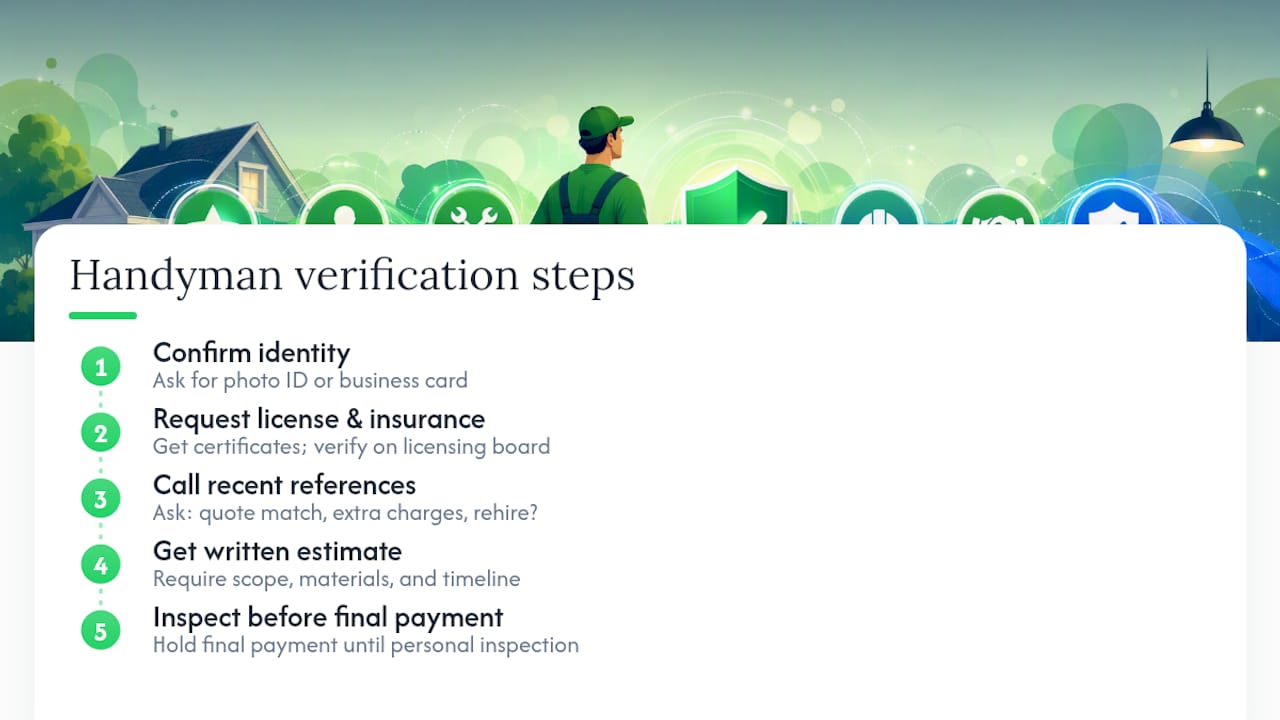
Calling references matters more than most homeowners think. Ask specifically: did the work match the written quote, were there unexpected charges, and would they hire this person again for a different job. A hesitant or vague answer to any of those three questions is a signal worth taking seriously, even if the reviews looked spotless.
Insurance and licensing verification doesn't take long. Ask for a copy of the certificate of insurance and, where the job requires it, the specific trade license number, then check it against your state's licensing board site if one exists. Redfin's guide for hiring a handyman puts this bluntly: for anything beyond small cosmetic fixes, reviews alone are not sufficient, and you need documented proof, not just a claim on a profile page. A pro who hesitates, stalls, or gets defensive when you ask for these documents is telling you something important before the job even starts.
Some platforms add another layer worth knowing about. Diamond Certified, for example, runs an audited verification program that checks a provider's legal, financial, and customer satisfaction history beyond self-reported reviews. That kind of third-party audit adds real weight that ordinary star ratings don't carry.
Pro Tip: Ask for the certificate of insurance to be emailed to you directly, not just described over the phone. A legitimate provider can send it in minutes.
Red Flags in Reviews and Profiles You Shouldn't Ignore
Most fake reviews follow a pattern once you know what to look for. A profile with 40 reviews, 30 of which arrived in the same two-week window, using suspiciously similar phrasing, is a strong sign of a manufactured review push rather than organic feedback. Reviewer accounts with no activity outside that single glowing post are another tell.
Operational red flags matter just as much as review manipulation. Watch for a handyman who refuses to put anything in writing, insists on cash only, gives you a phone number that doesn't match their listed business name, or won't provide a single reference. None of these alone is disqualifying, but stacked together they describe someone who's hard to hold accountable if something goes wrong.
One bad review is a data point. A pattern of three or more describing the same failure, whether it's missed deadlines, hidden fees, or unfinished work, is a warning you should not talk yourself out of.
There's a real difference between an isolated complaint and a pattern. Every busy handyman has one unhappy customer somewhere in their history; that's normal. What matters is whether the negative feedback repeats the same specific issue across multiple, unrelated reviewers. If you spot that pattern, move on to the next name on your list rather than assuming you'll be the exception.
A Hiring Workflow That Puts Reviews to Work
Reviews only pay off when you use them inside a repeatable process instead of scrolling until one name feels right.
- Build a shortlist of at least three pros. Pull names from Google Reviews, Angi, Thumbtack, and word-of-mouth recommendations from neighbors. Angi's own hiring guidance specifically recommends comparing multiple providers rather than settling on the first decent-looking profile, since price and availability often vary more than homeowners expect.
- Score each candidate on the same criteria. Communication speed, review specificity, price transparency, and whether they offer any kind of workmanship guarantee. Writing these down side by side, even in a simple notes app, makes the comparison honest instead of gut-feel.
- Call or message each one with the same three questions. Can you share a reference from a similar job? What's included in your estimate versus billed separately? What happens if something needs to be fixed after you leave? A confident, specific answer to all three is a good sign. A vague answer to any one of them is worth a follow-up question before you decide.
- Get written estimates from at least two finalists. Compare scope and materials line by line, not just the bottom-line number.
- Make the call and put the agreement in writing, including start date, completion date, and payment schedule tied to milestones.
When Reviews Aren't Enough: Jobs That Need Licensed Trades
Some jobs are too risky to hand to whoever has the best star rating, no matter how glowing the reviews read.
Structural changes, major electrical work, plumbing that involves gas lines or main water shutoffs, and anything requiring a building permit fall into this category. Reviews might tell you a contractor is friendly and shows up on time, but they say nothing about whether the wiring they installed will pass inspection. Redfin's expert guidance is direct on this point: for regulated work, verify licensing, bonding, and permit history before anything else, because the risk of a failed inspection or an insurance denial after an accident falls entirely on the homeowner.
Take a kitchen remodel that involves moving a load-bearing wall, or a full rewire of an older home's electrical panel. These aren't handyman jobs in the traditional sense, even if a general handyman offers to take them on. They call for a licensed electrician or a licensed general contractor who can pull permits and pass inspection, and no number of five-star reviews changes that requirement.
Great reviews tell you someone is pleasant to work with. They don't tell you whether the wiring behind your wall will pass an inspector's checklist.
For this category of work, ask directly for the license number, confirm it's active with your state board, and request proof of bonding in addition to insurance. Reviews still matter here as a supplement, showing you how the person communicates and handles setbacks, but they sit behind the paperwork, not in front of it.
A One-Page Checklist Before You Hire
Print this or save it to your phone before your next call.
- Confirm the platform marks reviews as verified transactions, not open text submissions.
- Read at least five recent reviews (within the last six months) for specific task details, not generic praise.
- Look for before-and-after photos and note whether any reviewer mentions an inspection or permit.
- Request a copy of insurance and, if applicable, license documentation before the job starts.
- Call one reference and ask if the final price matched the original quote.
- Get a written estimate covering scope, materials, and timeline.
- Hold final payment until you've personally inspected the completed work.
- Record contact details, quoted price, and agreed completion date in the space below for your own reference.
Contact name & number: ________________________ Quoted price: ___________ Completion date: ______
What I've Learned From Watching This Process Play Out
Homeowners tend to treat reviews as a shortcut around due diligence, and that instinct is understandable. Nobody wants to call three references and read a certificate of insurance line by line when a five-star average is sitting right there.
But the pattern that actually predicts a bad hire isn't a low star rating. It's usually a handyman with plenty of praise for small, low-stakes jobs and zero verifiable history with anything close to what you need done. A review that says "great, fixed my cabinet hinge" tells you nothing about whether that same person should touch your electrical panel. The mismatch between what the reviews cover and what your job actually requires is where most regret starts.
The fix isn't ignoring reviews. It's reading them for what they actually reveal, specific behavior and communication patterns, and then closing the gap with documentation for anything that carries real risk. If you're comparing options for a multi-trade job that spans several skill sets, that gap tends to widen, since one glowing review about tiling says nothing about someone's electrical competence.
If you're weighing a handyman or renovation job right now and want a second opinion on scope or pricing, reach out. A quick conversation before you sign anything usually saves more than it costs.
Why Homeowners Choose Honestbuilders Over a Trial-and-Error Hire
Skip the guesswork of piecing together reviews from five different platforms. Honestbuilders is built on two things reviews alone can't verify from a screen: workmanship you can hold us to, and accountability when something needs a second look.
We handle handyman work, from furniture assembly to minor repairs, and full residential renovation across HDB, condo, and landed properties, including hacking, electrical, plumbing, tiling, carpentry, painting, and space planning. Commercial renovation and interior film application round out what we take on, island-wide. Every project comes with a written estimate up front and a workmanship warranty behind it, so you're not relying on a stranger's online review to tell you whether the job will hold up. No hidden charges, no runaround if something needs fixing after we leave.
WhatsApp us at +65 9447 9696 or visit Honestbuilders for a free, no-obligation quote before your next project.
Where To Check Reviews and Verify a Handyman
Cross-referencing platforms catches inconsistencies a single site can hide.
- Google Reviews: Best for a quick overview and checking how a business responds publicly to complaints.
- Yelp: Strong for detailed, narrative reviews and photo documentation of past jobs.
- Angi / HomeAdvisor: Reviews are often tied to a matched or booked service request, which adds verification strength.
- Nextdoor: Useful for neighbor-level trust and local reputation, though verification is limited.
- Thumbtack: Reviews generally come from customers who booked through the platform, giving them solid transaction backing.
- For licensing verification, check your state or city's contractor licensing board website directly rather than relying on a platform's self-reported badge.
- Look across at least two platforms for the same provider before deciding whether a pattern of praise or complaints is real.
Sources
- How to Find a Great Handyman
- How to Hire a Handyman: 10 Questions to Ask | Redfin
- No-more-diy-disasters: Tips for finding a reliable handyman | Yelp Blog
- Qualitative study on eWOM and online consumer decision-making