
"Types of locksmith handyman services" — as used here — refers to on-site handyman and renovation work, not lock or key services. This article covers the full range of on-site services you can hire for your home or business:
- Handyman repairs and installations (furniture assembly, fixture swaps, minor plumbing, minor electrical)
- Residential renovation (hacking, tiling, carpentry, painting, electrical, plumbing, space planning)
- Commercial renovation (offices, shops, warehouses)
- Interior film application (walls, furniture, fixtures)
Licensing and permit requirements vary by state. Always check with your local building department before work begins.
Pro Tip: If a contractor can't tell you which permits apply to your job, that's your first red flag — not a minor oversight.
Key Takeaways
Hiring the right handyman comes down to verifying credentials, getting a written scope, and knowing when the job needs a licensed specialist instead.
| Point | Details |
|---|---|
| Match service to scope | Handymen suit minor repairs and installs; licensed contractors handle structural, panel, and full-system work. |
| Licensing varies by state | Always check your local building department and state licensing board before work begins. |
| Get everything in writing | A written estimate covering scope, cost, schedule, warranty, and cleanup protects you if disputes arise. |
| Verify insurance and license | Request a certificate of insurance and confirm any license number through your state's online lookup tool. |
| Honestbuilders | Covers handyman, residential renovation, commercial renovation, and interior film — with upfront pricing and a workmanship warranty. |
Table of Contents
- What types of on-site handyman services do homeowners actually need?
- What a handyman can do vs. what requires a licensed contractor
- When should you hire a licensed specialist instead?
- How to choose and vet a handyman before you hire
- What handyman work typically costs and how long it takes
- What Honestbuilders prioritizes in every job
- Get a no-obligation quote from Honestbuilders
- Useful resources for licensing and permit verification
- Sources
What types of on-site handyman services do homeowners actually need?
A handyman is a versatile generalist who handles drywall repair, interior painting, furniture assembly, appliance installation, and basic electrical or plumbing fixture work — depending on local licensing. Some specialize further: a handyman electrician or handyman plumber carries trade credentials that expand what they can legally do in your state.
Here's how the most common service categories break down:
Interior repairs and finishing: Patching drywall, fixing squeaky doors, replacing trim, caulking gaps. Example: a bedroom wall patch after a doorknob punched through.
Carpentry and shelving: Installing built-in shelving, baseboards, crown molding, and custom storage. Example: floating shelves in a home office.
Painting and drywall: Full-room repaints, accent walls, skim-coating over old texture. Example: repainting a rental unit between tenants.
Tile and flooring: Backsplash installation, floor tile replacement, grout repair. Example: a cracked kitchen backsplash tile replaced to match the existing pattern.
Minor electrical: Swapping outlets, installing ceiling fans, replacing light fixtures. Anything touching the panel or adding circuits typically requires a licensed electrician.
Minor plumbing: Faucet replacement, toilet repairs, showerhead swaps, supply line fixes. Full reroutes require a licensed plumber.
Furniture and appliance installation: Flat-pack assembly, dishwasher hookups, over-range microwave mounting.
Outdoor and seasonal: Gutter cleaning, deck board replacement, pressure washing, fence repairs, porch maintenance.
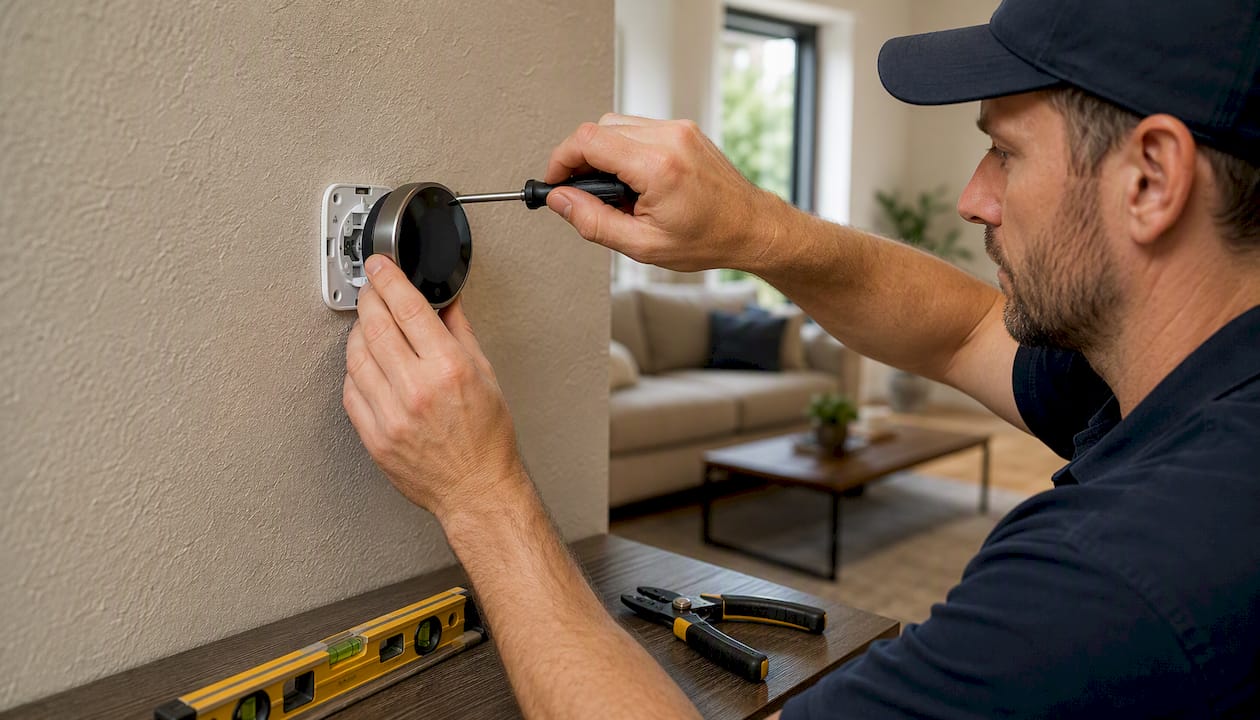
Smart-home and tech installs: Programmable thermostats, video doorbells, smart locks, security cameras, and connected lighting.
Commercial fit-outs: Office partition installs, retail shelving, warehouse racking, and minor tenant improvements that don't require structural changes.
| Category | Representative tasks | Handyman or specialist? |
|---|---|---|
| Interior repairs | Drywall patch, door adjustment, caulking | Handyman |
| Painting | Room repaint, trim, accent wall | Handyman |
| Tile and flooring | Backsplash, floor tile, grout | Handyman (for minor work) |
| Minor electrical | Fan install, outlet swap, fixture | Handyman (no panel work) |
| Minor plumbing | Faucet, toilet, showerhead | Handyman (no reroutes) |
| Smart-home installs | Thermostat, doorbell, smart lock | Handyman |
| Structural or panel work | Load-bearing walls, service panel | Licensed contractor |
Specializing in higher-skill tasks like tile, smart-home installs, or custom carpentry tends to command higher rates and is worth seeking out when your job demands precision.
What a handyman can do vs. what requires a licensed contractor
The practical rule in most U.S. states: a handyman handles smaller, non-structural tasks that don't require pulling permits. Once a job touches structure, primary electrical service, gas lines, or major plumbing systems, you're in licensed-contractor territory.
Typically safe for a handyman:
- Furniture assembly and appliance hookups
- Painting, patching, and drywall repair
- Fixture-level plumbing (faucets, toilets, supply lines)
- Fixture-level electrical (outlets, fans, light fixtures — no panel work)
- Tile installation for cosmetic updates
- Smart-home device installation
- Gutter cleaning, pressure washing, deck board replacement
Usually requires a licensed contractor or permit:
- Load-bearing wall removal or structural modifications
- Electrical panel upgrades, new circuits, or service changes
- Full bathroom or kitchen plumbing reroutes
- HVAC system installation or replacement
- Commercial tenant improvements governed by the International Building Code (IBC)
- Any work that triggers a local building inspection
State rules vary significantly. California, for example, sets a dollar threshold below which a handyman can work without a contractor's license; Texas has different rules by trade. Your local building department is the authoritative source — not a contractor's word.
Pro Tip: Before booking, ask the handyman directly: "Does this job require a permit, and who pulls it?" A professional will know. If they hesitate or say permits "aren't necessary," verify independently.
When should you hire a licensed specialist instead?
Hire a licensed specialist for anything that affects structural integrity, household service capacity, or public safety. That's not a conservative suggestion — it's the line most state codes draw.
Jobs that should go to licensed specialists:
- Full bathroom re-plumb — a licensed plumber, not a handyman, owns this scope
- Electrical panel changes or new circuits — licensed electrician, full stop
- Load-bearing wall removal — requires a structural engineer and a general contractor
- HVAC installation or replacement — licensed HVAC technician
- Commercial tenant improvements — commercial contractor license, separate bonding, and higher insurance minimums than residential work requires
Residential contractor licenses typically cover one- and two-family dwellings under the International Residential Code (IRC). Commercial work follows the IBC and requires a separate license classification. A contractor licensed only for residential work cannot legally take on most commercial projects.
Mid-borderline jobs — a partial bathroom update, adding a dedicated outlet, or a small kitchen upgrade — often depend on local rules. For these, request the contractor's license number, verify it through your state licensing board's online lookup, and ask for a certificate of insurance naming you as an additional insured.
How to choose and vet a handyman before you hire
The fastest way to cut hiring risk: verify identity, insurance, references, and get everything in writing before anyone picks up a tool.
Hiring checklist — documents to request:
- Proof of general liability insurance (ask for the certificate, not just their word)
- Business registration or license number, if your state requires one for the work type
- Two or three references from jobs similar to yours
- Portfolio photos of comparable completed work
- A written estimate covering scope, materials, schedule, warranty terms, and cleanup responsibilities
Questions to ask during the quote:
- What's the timeline, and what could extend it?
- Are materials included, or billed separately?
- Who is responsible for pulling permits if needed?
- What does your warranty cover, and for how long?
- How do you handle damage or rework?
Red flags to walk away from:
- No written estimate — only a verbal quote
- Cash-only payment with no receipt
- Vague or no warranty commitment
- Pressure to decide immediately or pay a large deposit upfront
- Reluctance to provide license or insurance documentation
Pro Tip: Check your state contractor licensing board's website before the first call. A two-minute lookup tells you whether a license is active, expired, or has complaints — information no amount of charm can override.
A multi-trade handyman who carries credentials across plumbing, electrical, and carpentry can handle more scope under one booking, which cuts coordination time on complex jobs.
What handyman work typically costs and how long it takes
Price and timeline depend on four things: task complexity, materials, local labor rates, and whether the job is standard hours or emergency/after-hours. The ranges below are illustrative estimates — get local quotes before budgeting.
Pricing factors:
- Hourly vs. flat-rate billing (flat-rate is easier to budget; hourly suits open-ended jobs)
- Materials: supplied by you or sourced by the handyman (with markup)
- Permit fees, when applicable
- Emergency or after-hours premiums (often 25–50% above standard rates)
- Travel time for mobile handyman availability in rural or suburban areas
All figures are illustrative estimates for general planning. Actual costs vary by location, materials, and job specifics. Always get at least three written quotes.
Commercial jobs carry additional budget lines: permit expediting, professional fees, and business-interruption contingency. A retail fit-out or office renovation typically runs longer and costs more per square foot than equivalent residential work. This is partly because IBC compliance adds inspection steps.
What Honestbuilders prioritizes in every job
The standard that actually matters in handyman and renovation work isn't the lowest quote — it's whether the work holds up six months later and whether the contractor stands behind it. Honestbuilders operates on two principles: workmanship and accountability. That means showing up on time, doing the job to code, and not disappearing when a follow-up question comes in. For regulated work, licensed specialists handle the scope that requires them. Pricing is quoted upfront with no hidden charges added after the fact. A workmanship warranty backs every completed project.
Get a no-obligation quote from Honestbuilders
Honestbuilders covers the full range of on-site handyman and renovation work: furniture assembly, fixture installations, minor repairs, residential renovation (tiling, carpentry, painting, electrical, plumbing), commercial renovation for offices and retail spaces, and interior film application for walls and furniture. No hidden charges, no runaround — just a clear scope and a price before work starts.

Visit Honestbuilders to request a free, no-obligation quote. Describe your job, and the team will confirm scope, timeline, and pricing in your first contact.
Useful resources for licensing and permit verification
- Bob Vila — What Does a Handyman Do? — Clear breakdown of handyman scope and specializations; useful for setting expectations before you hire.
- Your state contractor licensing board — Search "[your state] contractor license lookup" to verify any license number in real time.
- Your local building department — The authoritative source for permit requirements, inspection sequences, and what work triggers a permit in your jurisdiction.
- Redfin — Hiring a Handyman — Practical checklist of questions to ask and contract terms to require.
- Renovation Authority — Commercial vs. Residential Renovation — Explains IBC vs. IRC code differences and what they mean for your project type.
- Consumer Financial Protection Bureau (CFPB) and your state Attorney General's office — Both maintain contractor complaint databases worth checking before signing any agreement.
Sources
- What does a handyman do? — common tasks and specializations
- Handyman list ideas — 30 service types and how to choose which to offer
- Hiring a handyman — what to ask and why a contract matters
- Commercial vs. residential renovation: key differences and code implications
- Residential vs commercial contractor services: scope differences