
What does the BTO renovation process actually involve?
The BTO renovation process in Singapore typically runs several months from key collection to move-in, and it starts earlier than most first-time homeowners expect. Before a single wall gets hacked, you need an HDB Renovation Permit. Without it, your contractor cannot legally begin structural, wet, or electrical works.
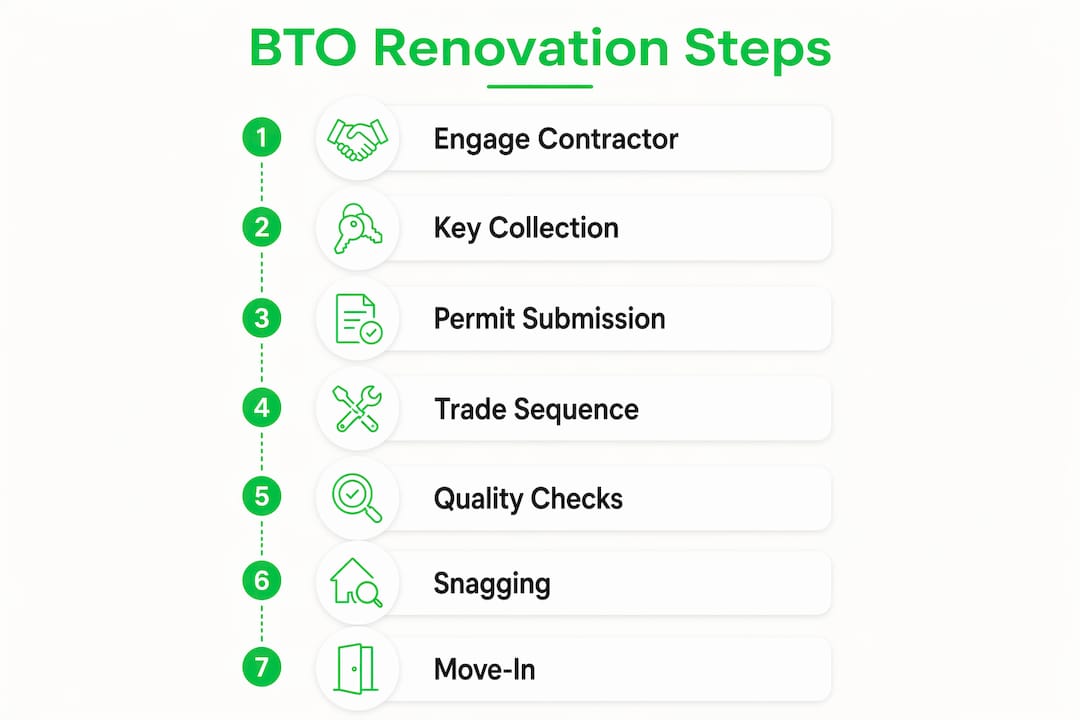
Here is the sequence at a glance:
- Pre-key collection (6–8 weeks out): Engage your contractor or interior designer and finalize your design scope
- Key collection day: Conduct a thorough defect inspection and photograph every issue
- Week 1–2: Submit the HDB Renovation Permit application through the MyHome portal
- Week 2–4: Permit approval takes 1–3 weeks after submission
- Week 4–16: Renovation works proceed by trade, lasting 8–14 weeks depending on scope
- Week 16–20: Snagging, cleaning, and move-in preparation
Most 4-room and 5-room BTO renovations generally take several months from key collection to move-in. The biggest variable is how early you locked in your contractor.
Step-by-step BTO renovation guide: from before your keys to move-in
1. Engage your contractor well in advance before key collection
This is the phase most guides skip. Design, material selection, and permit submission all need to run in parallel, not in sequence. If you wait until key collection day to start looking for a contractor, you lose weeks of overlap that keep the project on schedule. Finalize your design scope and get quotations signed off before you even hold the keys.

2. Collect your keys and inspect for defects immediately
Key collection day is the starting gun, not the finish line. You have a short window from collection to submit defects to HDB for rectification. Miss that window and any defect you overlooked becomes your cost to fix.
Do the defect inspection on collection day or the next morning. Bring a torch, a marble for floor levelness, and your phone for photos. Check:
- Wall-ceiling junctions for hairline cracks
- Door and window frame alignment
- Bathroom tile grouting for gaps or incomplete joints
- Window seals at the frame-wall joint
- Floor levelness (a marble placed at center should not roll toward any wall)
Run a ponding test in all wet areas: block the floor drain, fill with 25mm of water, and leave for 24 hours. If water seeps into adjacent areas, waterproofing has failed. Submit every defect through HDB's portal the same day if possible.
Pro Tip: Photograph every defect with a timestamp before your contractor begins any works. This protects you if disputes arise later about what was pre-existing damage versus renovation-related.
3. Submit the HDB Renovation Permit within the first two weeks.
The permit is not optional. Only contractors registered under HDB's Directory of Renovation Contractors (DRC) can submit the application through the MyHome portal. Verify your contractor's DRC registration before signing any contract. Approval typically takes 1–3 weeks, so submitting promptly lets the approval window overlap with your pre-works preparation rather than delaying it. For a full breakdown of what the permit covers, the HDB renovation works guide is worth reading before you finalize your scope.
4. Follow the required trade sequence during renovation works
HDB BTO renovations follow a strict order of trades. Skipping or reordering steps creates problems that are expensive to fix once walls are closed and tiles are laid.
- Hacking and demolition
- Waterproofing (bathrooms and yard)
- Plumbing and drainage
- Electrical first fix (wiring before plastering)
- Plastering and screeding
- Tiling (floors and walls)
- Carpentry and millwork
- Electrical second fix (outlets, switches, fixtures)
- Painting
- Finishing and installation
One rule that catches many BTO owners off guard: you cannot hack existing bathroom tiles within three years of the block's completion date. You can overlay tiles or regrout during this period, but a full strip-and-retile is not permitted. Confirm the exact rule at hdb.gov.sg before finalizing your bathroom scope.
5. Conduct milestone quality checks at each trade completion
You do not need to be on site every day. You do need to check each trade before the next one begins. The milestone inspection checklist covers the critical points:
| Trade milestone | What to verify before proceeding |
|---|---|
| After hacking | Only approved structural changes; photograph walls before plastering |
| After waterproofing | Request ponding test pass certificate before any tiling |
| After tiling | Grout consistency; floor gradient toward drains in wet areas |
| After carpentry | Test all drawers, doors, and soft-close mechanisms |
| After painting | Walk in daylight; check for drips, roller marks, color inconsistencies |
| Final handover | Produce a written snagging list before signing off |
Request progress photos from your contractor for any milestone you cannot attend in person.
6. Review provisional sums before signing your contract
Provisional sums are line items priced as estimates rather than fixed amounts. Waterproofing and hacking appear this way most often. A provisional waterproofing sum of S$800 can become S$2,500 once the actual floor area is measured on site. Circle every provisional sum in your contract and ask for a realistic worst-case figure before you sign. The renovation progress payment guide explains how to structure payment schedules to protect yourself at each stage.
7. Complete snagging and move-in preparation
Snagging runs 2–4 weeks before move-in. Walk through every room with your contractor and produce a written list of items to rectify. Do not make final payment until the snagging list is cleared. Clean the flat thoroughly after all works are done, since construction dust settles into corners and behind cabinets long after the last trade leaves.
Expert planning tips for a future-ready BTO renovation
The most common planning mistake is designing for today without thinking about the next decade. Lifestyle mapping, which means thinking through how your household might grow or change over 5–10 years, helps you avoid costly redoing later. A young couple planning to start a family, for example, benefits from leaving one room as a flexible space rather than committing it to a fixed purpose immediately.
The choice between a bare unit and HDB standard finishing is a real fork in the road. HDB finishing reduces upfront renovation costs by giving you basic floors, walls, and ceiling. A practical middle path is to use HDB finishing for the base shell and invest the saved budget in built-in storage, wardrobes, or kitchen cabinetry where you will feel the difference daily.
Modular furniture and phased upgrading are worth considering for first-time homeowners who are not yet sure how they will actually use the space. Start with affordable, flexible pieces, then layer in custom fitted elements once you have lived in the flat for a few months. This approach avoids locking a large budget into built-ins you might want to change within two years.
Pro Tip: Prioritize durable, low-maintenance finishes in high-traffic areas like the kitchen and bathrooms. These are the rooms where quality of materials shows up most in daily life, and where cutting costs tends to create the most regret.
Avoiding common kitchen renovation mistakes during planning, such as underestimating storage needs or ignoring ventilation, saves both money and frustration down the line.
How to choose a reliable contractor and maintain quality throughout
Only DRC-registered contractors can legally submit HDB renovation permit applications and carry out structural, wet, or electrical works in your flat. Verify registration on HDB's website before signing anything. A contractor who cannot show DRC registration is a contractor who cannot legally start your renovation.
Workmanship and accountability are not just values to advertise. They are the two things that determine whether a renovation project ends well or ends in dispute. Every milestone check, every documented defect, every provisional sum clarified upfront, these are the practices that separate a smooth renovation from a stressful one. Choose a contractor who welcomes that level of scrutiny, not one who discourages it.
Honestbuilders brings both values to every BTO project, with no hidden charges and clear accountability at each stage. The HDB renovation checklist covers the full sequence of quality checks from defect inspection through final handover.
Key quality assurance actions to take throughout your renovation:
- Verify DRC registration before signing any contract
- Document all defects with photos within 7 days of key collection
- Request a ponding test certificate before tiling begins in wet areas
- Clarify all provisional sums and get worst-case estimates in writing
- Conduct milestone checks at each trade completion
- Produce a written snagging list before making final payment

Ready to get your BTO renovation right from day one? Honestbuilders handles everything from permit application to final handover, with full transparency and no runaround. WhatsApp +65 9447 9696 for a free, no-obligation quote.
Key Takeaways
A BTO renovation in Singapore typically takes 14 to 20 weeks from key collection to move-in, and the permit, defect inspection, and contractor engagement must all happen in the first two weeks to keep the timeline on track.
| Point | Details |
|---|---|
| Start early | Engage your contractor 6–8 weeks before key collection to allow design and permit prep to run in parallel. |
| Defect inspection is urgent | You have 7 days from key collection to submit defects to HDB; anything missed after that is your cost. |
| Permit before works | Submit the HDB Renovation Permit within 1–2 weeks of key collection; approval takes 1–3 weeks. |
| Milestone checks prevent rework | Verify each trade before the next begins, especially waterproofing before tiling. |
| Watch provisional sums | Ask for worst-case estimates on all provisional line items before signing your contract. |
What most BTO renovation guides get wrong
The advice to "plan early" gets repeated everywhere, but rarely with enough specificity to change behavior. The defect inspection window is the clearest example. Most first-time homeowners treat key collection day as a celebration and assume HDB has already done a thorough quality check. They have not. The 7-day window is short and unforgiving, and the defects that get missed, hairline cracks at wall-ceiling junctions, incomplete grouting in wet areas, window frame gaps, are exactly the ones that become expensive problems once renovation works begin.
The other oversight I see consistently is treating the renovation as a one-time, all-or-nothing commitment. It does not have to be. Starting with HDB finishing and modular furniture, then layering in custom elements as you understand how you actually live in the space, is a genuinely better approach for most first-time homeowners. It costs less upfront, reduces decision fatigue, and produces a home that fits your real life rather than your imagined one.
Transparency from your contractor matters as much as their portfolio. A contractor who welcomes milestone checks, documents defects openly, and explains provisional sums clearly is one who is confident in their work. That confidence, backed by accountability at every stage, is what Honestbuilders is built on.