HDB commercial unit reinstatement is defined as the process of restoring a leased commercial space to its original condition as specified in the tenancy agreement, before the unit is handed back to HDB. This obligation applies to all shop and office tenants operating within HDB premises. The reinstatement process for HDB is not optional. It is a regulatory requirement enforced by the Housing and Development Board, and failure to comply carries real financial consequences. Whether you are a first-time shop tenant or a seasoned property owner, understanding what is involved in HDB unit restoration requirements will save you time, money, and stress at the end of your lease.
What is HDB commercial unit reinstatement?
HDB commercial unit reinstatement is the formal obligation to undo all alterations, additions, and installations made during a tenancy and return the unit to the state it was in at the start of the lease. The industry term most commonly used is "reinstatement," and it applies specifically to the removal of tenant-installed works rather than any new improvement. This is a binding condition written into HDB commercial leases, not a recommendation.
The scope of reinstatement covers everything a tenant changed during occupancy. Partition walls, false ceilings, electrical fittings, plumbing modifications, floor finishes, and signage all fall under this obligation. If you installed it, you are responsible for removing it and restoring the original surface or system.
HDB's oversight role here is active, not passive. The Board sets the technical standards, approves the scope of works, and requires licensed professionals to carry out the job. HDB mandates that all contractors engaged for reinstatement must be licensed and listed in the HDB Directory of Renovation Contractors. That requirement exists to protect structural integrity and ensure every job meets building code.

What specific reinstatement work is required?
The types of work covered under HDB commercial unit guidelines are broader than most tenants expect. Common reinstatement items include:
- Removal of partition walls and glass dividers
- Dismantling of false ceilings and ceiling-mounted fixtures
- Removal of additional power points, wiring, and lighting circuits
- Restoration of plumbing to original configuration
- Removal of floor overlays, tiles, or vinyl installed by the tenant
- Stripping of wall claddings, decorative panels, and feature finishes
- Removal of signage, display systems, and custom joinery
Each of these items must be removed cleanly, with the underlying structure returned to its original condition. Patching, painting, and surface restoration are part of the job.
One area that catches tenants off guard involves structural claddings. HDB advises against installing claddings or decorative panels over structural elements such as columns and beams. Under the Building Control Act, these elements must remain accessible for mandatory periodic inspections. If a tenant has covered them, the cladding must be removed at the tenant's cost before the inspection can proceed. That cost is entirely avoidable if the cladding was never installed.
For mechanical and electrical works, reinstatement typically means restoring the electrical distribution board to its original circuit configuration, capping off any additional plumbing points, and removing supplementary air-conditioning systems. These are not DIY tasks. They require licensed electricians and plumbers who understand HDB's technical specifications.
Pro Tip: Document the unit's original condition with photographs on the first day of your tenancy. That record becomes your reinstatement blueprint and protects you from disputes at handover.
How is the HDB reinstatement process managed and approved?
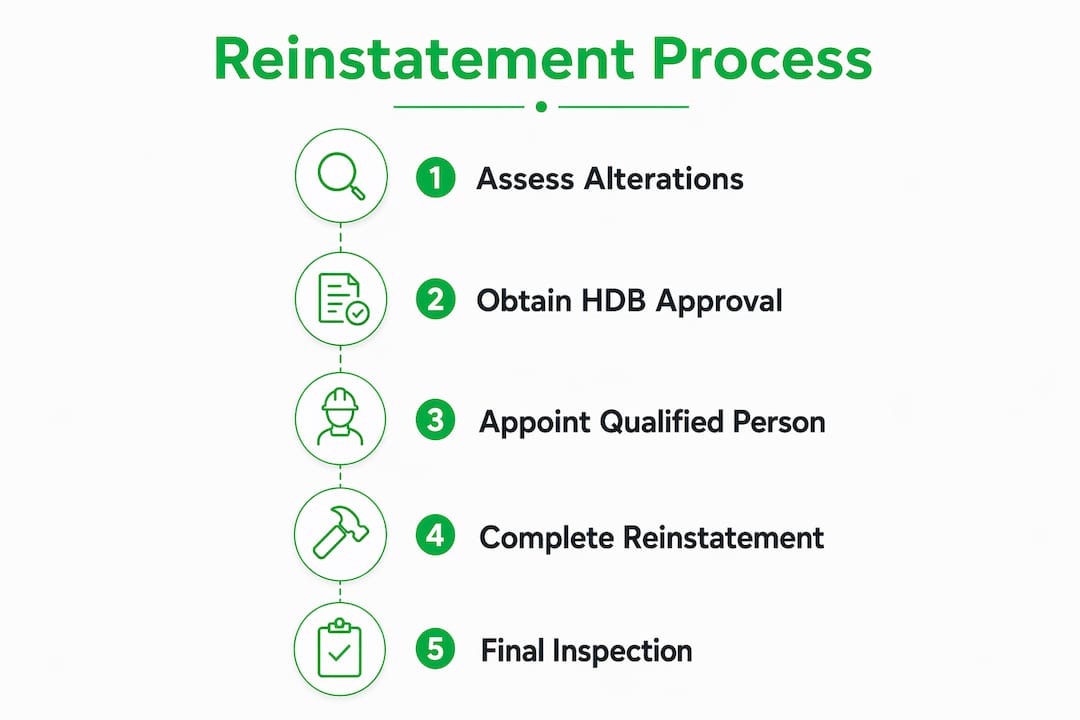
The reinstatement process for HDB follows a defined sequence. Skipping any step creates delays that can push past your lease end date.
- Review your lease agreement. Identify all reinstatement obligations written into your tenancy terms before planning any work.
- Obtain prior HDB approval. HDB requires prior approval before any reinstatement work begins. Starting without approval risks having to redo work that does not meet HDB's standards.
- Appoint a Qualified Person (QP) if required. For major structural or complex works, a registered architect or professional engineer must be appointed as the QP. HDB will not process applications for such works without one.
- Submit applications via CORENET. Applications must be lodged through CORENET with clearances obtained from relevant authorities including HDB, the Building and Construction Authority (BCA), and the Fire Safety and Shelter Department (FSSD).
- Engage a licensed contractor. Only contractors listed in the HDB Directory of Renovation Contractors may carry out the works.
- Complete works and submit compliance documentation. The tenant or owner must provide HDB with the required completion certificates and inspection records before the unit is formally handed back.
The approval timeline varies depending on the complexity of the works and whether a QP is involved. Simple reinstatement jobs may be processed within a few weeks. Complex structural works can take significantly longer. Many tenants underestimate this timeline and find themselves holding a lease past its end date.
Failure to reinstate on time can result in additional rent charges for every day the unit remains occupied beyond the lease end. That financial exposure grows quickly.
Pro Tip: Start the reinstatement planning process at least three months before your lease ends. QP appointments and CORENET submissions take time, and contractors book up fast near popular lease-end dates.
What are the costs and common challenges?
Reinstatement costs vary based on the size of the unit, the extent of alterations made during the tenancy, and the professional fees involved. Office reinstatement in Singapore ranges from S$15 to S$50 per square foot, depending on the scope of work required. A 1,000-square-foot shop unit could therefore cost anywhere from S$15,000 to S$50,000 to reinstate fully.
The factors that push costs toward the higher end include:
- Extensive structural alterations such as hacked walls or relocated plumbing
- Cladding removal required for Building Control Act inspections
- QP fees for managing complex applications
- Rectification works needed after a failed inspection
- Tight timelines that require contractors to work overtime
Hidden costs are the most common source of budget overruns. Tenants who installed claddings over structural columns face dismantling costs they did not plan for. Tenants who skipped the pre-approval step may need to redo work that does not meet HDB specifications. Both situations are avoidable with proper planning.
A thorough pre-termination inspection checklist reduces surprises. Walk the unit with your contractor before submitting any application and identify every item that requires reinstatement. Cross-reference that list against your original tenancy photographs. The renovation checklist approach used for residential units applies equally well to commercial reinstatement planning.
How does reinstatement differ from renovation in HDB commercial units?
Reinstatement and renovation are opposite processes, and confusing them creates compliance problems. Reinstatement restores a unit to its original lease condition, while renovation alters it through additions and modifications. The intent, scope, and regulatory triggers are entirely different.
| Aspect | Renovation | Reinstatement |
|---|---|---|
| Purpose | Alter or improve the unit | Restore to original condition |
| Timing | During tenancy | At tenancy end or handover |
| HDB trigger | Fitting-out permit required | Lease obligation at termination |
| Outcome | Unit is changed from original | Unit matches original lease state |
| Cost bearer | Tenant investing in the space | Tenant fulfilling lease obligation |
Renovation requires an HDB fitting-out permit before work begins. Reinstatement requires a separate reinstatement approval. The two processes use different application forms and may involve different sets of professional requirements.
A practical example clarifies the distinction. A food and beverage tenant who installs a custom exhaust hood, tiled splashbacks, and a grease trap during fit-out has completed renovation works. When the lease ends, removing that hood, restoring the wall surface, and capping the grease trap connection is reinstatement. The tenant pays for both, but they are governed by separate HDB processes. Understanding this distinction helps owners and tenants budget accurately across the full tenancy cycle. For a broader view of HDB renovation work types, the scope of what qualifies as alteration versus restoration becomes clearer.
Key Takeaways
HDB commercial unit reinstatement is a mandatory lease obligation requiring licensed contractors, prior HDB approval, and in many cases a Qualified Person, with costs ranging from S$15 to S$50 per square foot depending on the scope of work.
| Point | Details |
|---|---|
| Reinstatement is mandatory | All HDB commercial tenants must restore the unit to its original lease condition before handover. |
| Prior approval is non-negotiable | HDB requires written approval before any reinstatement work begins, with applications via CORENET. |
| QP involvement for complex works | A registered architect or professional engineer must manage applications for structural reinstatement. |
| Costs vary widely | Reinstatement runs S$15–S$50 per square foot; hidden costs from cladding removal and rectification add up fast. |
| Start early to avoid penalties | Late reinstatement triggers additional rent charges; begin planning at least three months before lease end. |
What I've learned from watching tenants get this wrong
The most expensive reinstatement jobs I've seen were not caused by complex structural works. They were caused by tenants who left everything too late. A tenant who starts the QP appointment process two weeks before lease end is already in trouble. The CORENET submission alone takes time, and contractors with the right HDB licensing are not always available on short notice.
The second most common error is assuming that a general contractor can handle HDB commercial reinstatement without checking the HDB Directory of Renovation Contractors first. HDB will not accept work done by unlisted contractors, regardless of how well the job was executed. That means the work gets rejected, the tenant pays twice, and the lease overrun clock keeps ticking.
Cladding is the third trap. Tenants install decorative panels over columns because they look good. They forget that the Building Control Act requires those columns to be inspectable. When the mandatory inspection comes around, the cladding has to come off. The tenant pays for dismantling, inspection, and reinstatement. That cost was entirely self-inflicted.
My honest advice: treat reinstatement as part of your tenancy budget from day one, not as a surprise at the end. The tenants who handle this smoothly are the ones who photographed the unit on move-in day, kept a running list of every alteration they made, and started the reinstatement conversation with a licensed contractor at least a quarter before lease end.
— Rayner
Honestbuilders can handle your HDB commercial reinstatement
HDB commercial reinstatement is one of the most compliance-heavy jobs a tenant faces. Honestbuilders handles the full scope, from pre-termination inspections and contractor coordination to licensed works and final documentation for HDB handover.

Every Honestbuilders project is carried out by contractors listed in the HDB Directory of Renovation Contractors, with no hidden charges and no runaround. Whether your unit needs simple fixture removal or a full structural reinstatement with QP oversight, the team delivers on time and to HDB's standards. Visit Honestbuilders or WhatsApp +65 9447 9696 for a free, no-obligation quote.
FAQ
What is HDB commercial unit reinstatement?
HDB commercial unit reinstatement is the process of restoring a leased commercial space to its original condition as specified in the tenancy agreement before the unit is returned to HDB. All tenant-installed alterations, fittings, and structures must be removed as part of this obligation.
Do I need HDB approval before starting reinstatement work?
Yes. HDB requires prior written approval before any reinstatement work begins. Starting without approval risks non-compliant work that must be redone at the tenant's expense.
When do I need a Qualified Person for reinstatement?
A Qualified Person, either a registered architect or professional engineer, is required for major structural or complex reinstatement works. HDB will not process the application without one.
How much does HDB commercial reinstatement cost?
Reinstatement costs range from S$15 to S$50 per square foot depending on the scope of work, the extent of alterations, and professional fees. Hidden costs from cladding removal or rectification works can push the total higher.
What happens if I miss the reinstatement deadline?
Late reinstatement results in additional rent charges for every day the unit is held beyond the lease end date. Planning works at least three months in advance reduces the risk of overrunning the deadline.