
Commercial renovation budget planning is the process of accurately estimating and managing all costs tied to refurbishing or remodeling a commercial property so the project stays financially on track. Done well, it separates projects that finish on time and on budget from those that spiral into costly overruns. The budget must account for hard costs like materials and labor, soft costs like permits and design fees, and a contingency fund sized to the building's condition and risk level. Soft costs alone represent 15–30% of total project budget and are the most commonly overlooked line item. Getting these numbers right before a single wall comes down is the single most important step in any commercial remodel budget.
What costs are included in a commercial renovation budget breakdown?
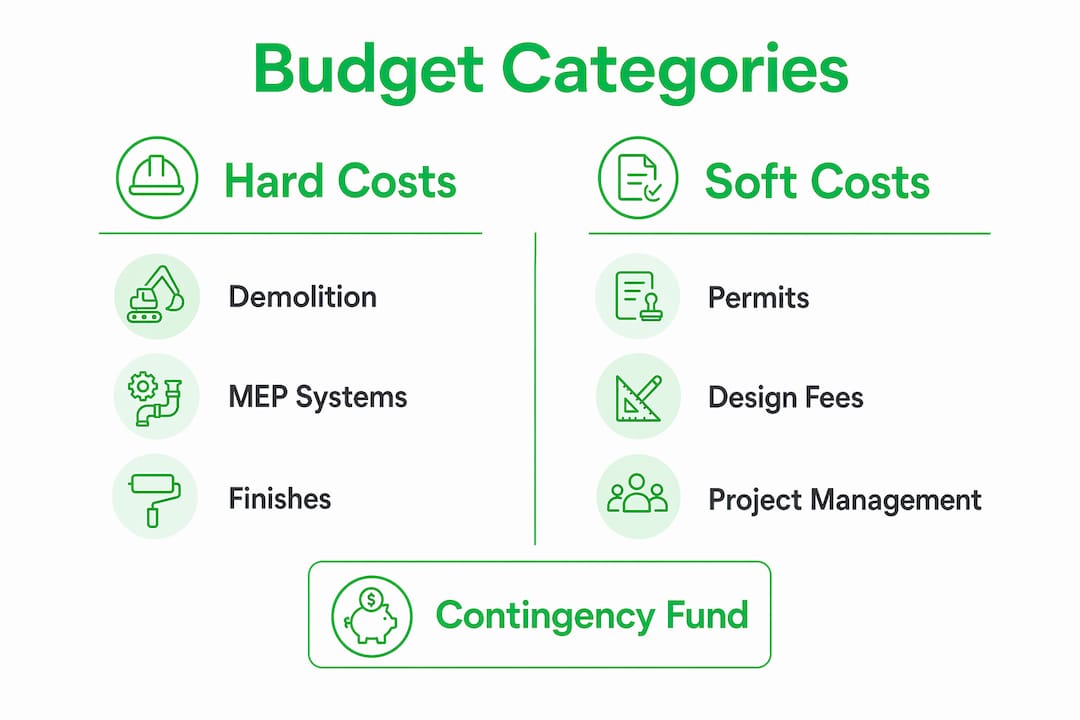
A complete commercial renovation budget breakdown divides spending into two main categories: hard costs and soft costs. Hard costs are direct construction expenses. Soft costs are everything else that makes the project legal, designed, and insured.
Hard costs
Hard costs cover demolition, structural work, mechanical, electrical, and plumbing (MEP) systems, flooring, ceilings, walls, and finishes. These are the line items most property managers think of first. Commercial renovation costs typically range from $50 to $300+ per square foot depending on scope. A simple cosmetic refresh runs $30–$75 per square foot, while a full gut renovation lands at $175–$300+ per square foot. Specialized spaces like restaurants and medical clinics sit at the higher end because their MEP systems are far more complex.
Soft costs
Soft costs include architectural and engineering fees, permit applications, legal compliance reviews, insurance, and project management. Ignoring soft costs is one of the most common budgeting mistakes, and it can sink a project before construction even begins. Budget 15–30% of your total project cost for this category. For a $500,000 renovation, that means $75,000–$150,000 in soft costs alone.
| Cost category | Examples | Typical share of budget |
|---|---|---|
| Hard costs | Demolition, MEP, framing, finishes | 70–85% |
| Soft costs | Permits, design fees, legal, insurance | 15–30% |
| Contingency fund | Unforeseen site conditions | 10–20% |
Contingency funds
A contingency fund is not a slush fund. Projects that skip the 10% contingency are frequently cited as the primary cause of budget failure. For modern buildings in good condition, allocate 10–15%. For older properties without full condition surveys, push that to 15–20%. The building's age and the quality of your pre-construction survey directly determine how much risk you are carrying.
Pro Tip: Break your budget into these three buckets before you speak to a single contractor. Walking into a quote meeting without this structure means you cannot evaluate whether a bid is complete or just cheap.
How to estimate your renovation costs realistically
Realistic renovation cost estimation starts with a clear scope. Unrealistic initial budgeting, not contractor error, is the leading cause of cost overruns. Property managers who define goals and scope before soliciting bids avoid scope creep and the budget failures that follow.
A practical estimation process follows these steps:
- Define the project scope in writing. List every space being touched, every system being upgraded, and every finish level you expect. Vague scope produces vague bids and real surprises later.
- Conduct a building condition assessment. Walk the site with a licensed engineer or quantity surveyor before budgeting. Hidden structural issues, outdated electrical panels, and asbestos in older buildings all affect cost dramatically.
- Use current local pricing, not national averages. Regional cost variations of 20–40% exist for similar project types across different markets. An internet calculator built on national averages will mislead you. Get actual quotes from local subcontractors.
- Factor in escalation. Material and labor costs rise over time. If your project spans six months or more, build in a cost escalation buffer of 3–5% annually on top of your base estimate.
- Engage a quantity surveyor or professional estimator. For projects above $200,000, a professional cost plan pays for itself. A quantity surveyor produces a line-by-line estimate that holds contractors accountable and gives you a defensible number for financing or board approval.
Pro Tip: Ask your estimator to provide three scenarios: base case, mid-range, and worst case. The gap between base and worst case is your real risk exposure, not just the contingency percentage.
Good space planning also feeds directly into cost estimation. A well-planned layout reduces unnecessary demolition and material waste, which cuts hard costs before the first quote arrives.
What are the best practices for managing renovation costs during the project?
Cost management for renovations does not end when the budget is approved. Active financial oversight throughout construction is what keeps the numbers from drifting.
The most common causes of cost overruns during construction are:
- Scope creep. The owner adds features mid-project without adjusting the budget. Every addition must go through a formal change order with a written cost impact.
- Uncontrolled contingency use. Teams dip into contingency for design upgrades rather than genuine site surprises. This depletes the safety net before the project is finished.
- Delayed decisions. Late material selections or slow permit approvals push timelines out and increase labor costs as crews sit idle.
- Inadequate contractor oversight. Without regular site meetings, small problems compound into expensive rework.
- Hidden soft costs. Legal fees, additional permit revisions, and extended insurance coverage accumulate quietly and are rarely tracked against the original budget.
Schedule weekly budget review meetings with your contractor and project manager. Review actual spend against the budget line by line, not just as a total. Any change order above a pre-agreed threshold should require written approval before work proceeds.
Phasing renovations and scheduling work after hours can reduce business downtime, but it increases construction costs by 10–20% due to off-hours labor premiums and site protection requirements. Account for lost revenue as a hidden cost in your financial planning for renovations. For many businesses, the revenue lost during a daytime shutdown exceeds the premium paid for night work.
Pro Tip: Set a change order freeze date two-thirds of the way through the project. After that date, no new owner-requested changes are approved unless they are safety-related. This single rule prevents the final stretch from blowing the budget.
How to prepare for unforeseen costs and risks in renovation budgeting
Every commercial renovation carries risk. The question is whether you have priced that risk into your budget before it shows up on site.
A thorough upfront site survey is the single best investment in risk reduction. Surveys reveal hidden structural damage, outdated utilities, and environmental hazards like asbestos or mold. Discovering these issues during design costs far less than discovering them during demolition.
"Contingency funds exist for unforeseen site conditions. They are not a discretionary upgrade fund. Using contingency for owner-requested design changes is one of the most reliable paths to budget failure." Proper contingency budgeting tailored to project risk is the foundation of financial resilience during any renovation.
Building age is the strongest predictor of contingency size. A 1970s warehouse carries far more hidden risk than a 2010 office fit-out. Contingency for older properties without full condition surveys should reach 15–20% of the total budget. Do not let optimism shrink this number.
After the project closes, the budget work is not finished. Budgeting for preventative maintenance post-renovation prevents costly emergency repairs and protects the long-term value of your investment. A newly renovated property with no maintenance reserve is a liability waiting to surface.
Common risk triggers to plan for include:
- Asbestos or lead paint in buildings constructed before 1990
- Undersized electrical panels that cannot support new equipment loads
- Plumbing that fails inspection once walls are opened
- Structural elements that do not match original drawings
- Permit delays caused by incomplete documentation
Key Takeaways
Effective commercial renovation budget planning requires accurate cost categorization, realistic local pricing, and disciplined contingency management from day one.
| Point | Details |
|---|---|
| Separate hard and soft costs | Soft costs run 15–30% of total budget and must be calculated before construction begins. |
| Size contingency to risk | Allocate 10–15% for modern buildings and 15–20% for older properties with unknown conditions. |
| Use local pricing | Regional cost variations of 20–40% make national averages unreliable for real project budgets. |
| Control change orders | Every scope addition needs a written cost impact before work proceeds to prevent budget drift. |
| Budget for maintenance | Post-renovation preventative maintenance reserves protect long-term property value. |
What I have learned from watching renovation budgets succeed and fail
Rayner here. After working on commercial renovation projects across shops, offices, and warehouses in Singapore, the pattern I see most often is not contractor failure. It is owner optimism at the budgeting stage.
Property managers come in with a number they want to spend, and they reverse-engineer the scope to fit it. That is backwards. The scope drives the cost. When you start with a fixed number and work backward, you end up cutting contingency, skipping the condition survey, and accepting the lowest bid without understanding what it excludes. Then the surprises hit, and suddenly the "savings" from that low bid are gone plus more.
The projects that finish well share one trait: the owner treated the budget as a living document. They reviewed it weekly, tracked every change order, and kept the contingency ring-fenced for genuine surprises. They also defined scope in writing before the first contractor walked the site. That single discipline, a written scope, eliminates more budget risk than any other tool.
One more thing: phasing is underrated. Breaking a large renovation into phases keeps cash flow manageable and gives you real cost data from phase one before committing to phase two. The upfront planning takes longer, but the financial control it delivers is worth every hour.
— Rayner
Honestbuilders can help you plan and execute your commercial renovation
Planning a commercial renovation budget is detailed work. Getting the numbers right before construction starts is what separates projects that finish cleanly from those that run over time and over budget.

Honestbuilders handles commercial renovation projects across shops, offices, and warehouses in Singapore with full transparency on costs and no hidden charges. The team brings the same accountability to a small office fit-out as to a full warehouse conversion. If you are at the planning stage and want a clear, honest cost picture before committing to a scope, WhatsApp Honestbuilders at +65 9447 9696 for a free, no-obligation quote.
FAQ
What is a realistic contingency percentage for commercial renovations?
Allocate 10–15% for modern buildings in good condition and 15–20% for older properties or sites without a full condition survey. Projects that skip at least a 10% contingency are frequently cited as the primary cause of budget failure.
What are soft costs in a commercial renovation budget?
Soft costs include permits, architectural and engineering fees, legal compliance, insurance, and project management. They typically represent 15–30% of the total project budget and are often underestimated or left out entirely.
How do I get an accurate renovation cost estimate?
Base your estimate on current quotes from local subcontractors, not national online calculators. Regional pricing variations of 20–40% make internet averages unreliable for real project budgets.
What causes commercial renovation budgets to go over?
Unrealistic initial budgeting and undefined project scope cause more overruns than contractor errors. Scope creep, misuse of contingency funds, and delayed decisions are the most common triggers once construction starts.
Should I budget for maintenance after the renovation is complete?
Yes. Budgeting for preventative maintenance post-renovation prevents costly emergency repairs and protects the long-term value of the property. Include a maintenance reserve as a line item in your original financial plan.