
A home repair package is a paid service contract or subscription that covers the cost of repairing or replacing major household systems and appliances when they fail from normal wear and tear. Think of it as a standing arrangement with a service provider, not a one-time fix. The essential elements are:
- What it covers: HVAC, plumbing, electrical systems, water heaters, kitchen appliances, and sometimes garage door openers or pool equipment
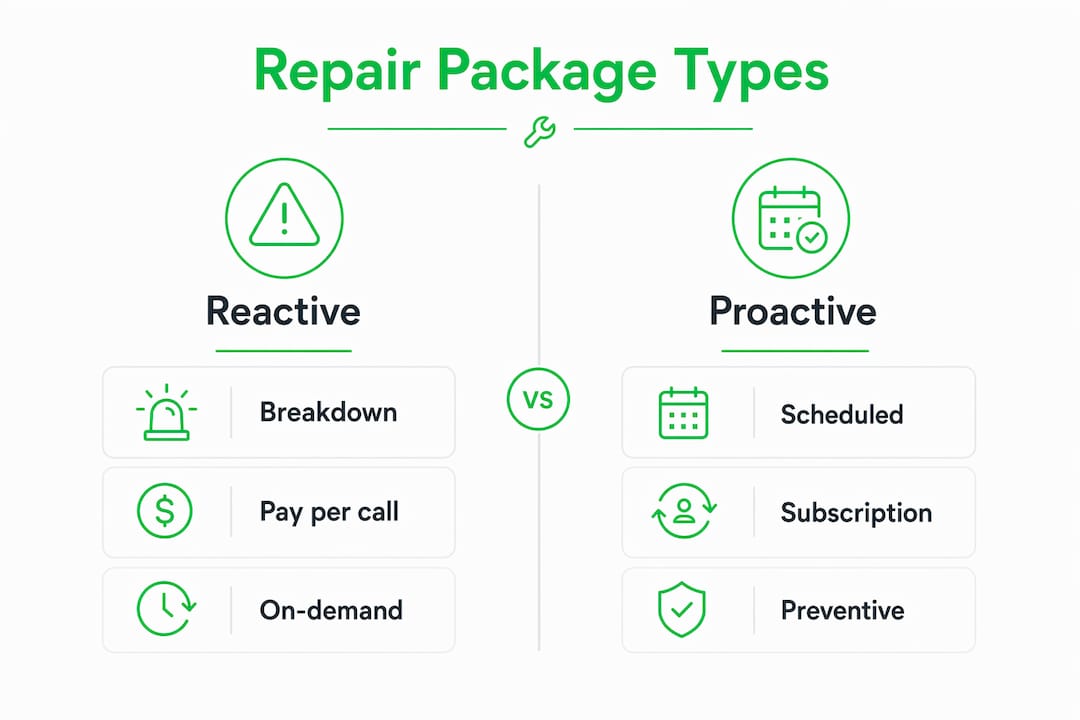
- Service model: Either reactive (you call when something breaks) or proactive (scheduled visits and preventive maintenance)
- Fees: A monthly or annual subscription, plus a per-dispatch service fee in most plans
- Who benefits most: Homeowners, landlords managing multiple units, and small businesses with aging mechanical systems
The two models serve different needs. Reactive plans pay out when things break. Proactive subscriptions schedule work before things break. Most homeowners need to understand both before signing anything.
Table of Contents
- What does a home repair package actually cover?
- How does a repair package differ from insurance or a warranty?
- Reactive vs. proactive packages: which model fits your situation?
- What does a home repair package cost?
- How to choose a home repair package: a practical checklist
- What happens after you submit a service request?
- When should you skip the package and use another route?
- Key Takeaways
- The part most homeowners overlook
- Honestbuilders: repairs and renovations done right in Singapore
- Useful sources and further reading
What does a home repair package actually cover?
Home repair plans typically fall into three types: appliance-only, systems-only, and combination plans. Combination plans are the most common purchase and the best value for most households.
Commonly covered items:
- HVAC systems (heating, ventilation, air conditioning)
- Plumbing (pipes, fixtures, water heaters)
- Electrical systems (panels, wiring, outlets)
- Kitchen appliances (refrigerators, dishwashers, built-in microwaves)
- Laundry appliances (washers, dryers)
- Garage door openers
For HDB and condo owners, the practical scope is narrower. Shared building systems like main water risers or common-area electrical panels fall under the MCST or HDB's responsibility, not your personal plan. A condo repair guide can help clarify that boundary before you buy. Landed homeowners and small commercial units have the broadest exposure and typically get the most value from combination plans.
Common exclusions to know:
- Pre-existing conditions or known defects at enrollment
- Cosmetic damage (scratches, dents, finish failures)
- Pest control and structural repairs
- Code-upgrade costs when a repair triggers a compliance requirement
- Secondary damage caused by a failed component
Statistic: Typical combination plans in the U.S. run $47–$82 per month ($564–$984 annually), before service call fees.
How does a repair package differ from insurance or a warranty?
These three products protect against completely different risks. Mixing them up leads to gaps in coverage and wasted money.
| Protection type | What triggers it | What it pays for | Who arranges service |
|---|---|---|---|
| Homeowners insurance | A named peril (fire, flood, theft) | Structural damage, liability, contents | You file a claim; insurer assigns adjuster |
| Manufacturer warranty | A defect in parts or workmanship | Parts and labor for the defective item | Manufacturer's authorized service center |
| Home repair package | Normal wear-and-tear failure | Repair or replacement of covered systems | Provider dispatches a vetted contractor |
| Maintenance subscription | Scheduled service interval | Preventive tasks, inspections, minor fixes | Provider sends a dedicated technician |
Homeowners insurance covers perils like fire or storm damage. A repair package covers the refrigerator compressor that quietly dies after ten years of use. Neither replaces the other.
Manufacturer warranties are narrower still: they cover defects in the specific unit, usually for one to three years, and they expire. A repair package picks up where the warranty ends.
Trust signals to verify for any plan:
- Proof that contractors hold current licenses and carry liability insurance
- A written service-level agreement (SLA) with response time commitments
- A workmanship guarantee on completed repairs (typically 30–90 days)
Pro Tip: Ask the provider whether technicians are W-2 employees or independent subcontractors. Employee-based models give the provider more control over quality and accountability.
Reactive vs. proactive packages: which model fits your situation?
These are genuinely different products, and one provider rarely does both well at the same price point.

Reactive (on-demand) protection works like a warranty extension. You pay a monthly premium, something breaks, you call, a technician comes out, you pay a service fee, and the plan covers the rest up to the coverage cap. Speed matters here. Proactive maintenance subscriptions deliberately schedule work to reduce failures and extend equipment life rather than waiting for the call.
| Feature | Reactive plan | Proactive subscription |
|---|---|---|
| Primary trigger | Breakdown | Scheduled visit |
| Cost structure | Premium + per-dispatch fee | Flat monthly fee, sometimes pooled hours |
| Main benefit | Financial protection on failures | Fewer failures, longer equipment life |
| Documentation | Work order per incident | Ongoing repair history vault |
| Best for | Homeowners with newer systems | Older homes, landlords, busy households |
Subscription plans with a dedicated handyman often include an encrypted documentation vault for receipts, serial numbers, and repair history, plus negotiated member rates for specialist trades. That paper trail is worth more than most homeowners realize until they try to sell the property or file an insurance claim.
For a landed property with aging plumbing and a full HVAC system, a proactive subscription usually pays for itself. For a newer HDB flat with mostly in-warranty appliances, a reactive plan or even direct-hire trades may be the smarter call.
What does a home repair package cost?
Pricing has three layers, and most people only budget for the first one.
- Monthly premium: Roughly $47–$82/month for standard combination plans in the U.S.
- Annual equivalent: $564–$984 before any service calls
- Per-dispatch service fee: $75–$125 each time a technician is sent out
- Coverage caps: Per-item limits (e.g., $1,500 for HVAC) and annual maximums that cap total payouts
Sample math: a homeowner paying $65/month ($780/year) who makes four service calls at $100 each spends $1,180 before a single dollar of repair cost is covered. If all four repairs are minor, the plan may cost more than paying out of pocket.
Monthly plan pricing also varies by home size and complexity. Providers typically conduct an initial assessment before quoting, and larger projects often carry a project management percentage fee on top of labor and materials.
Pro Tip: Some providers let you trade a higher service fee for a lower monthly premium. Run the math on your expected call frequency before choosing. If your systems are older and you expect three or more calls per year, a lower service fee usually wins.
Warning: Per-dispatch fees are the most common hidden cost in repair plans. Always calculate your estimated annual outlay as: (monthly premium × 12) + (expected dispatches × service fee) + any out-of-pocket overages above coverage caps.
How to choose a home repair package: a practical checklist
Run through this before signing anything.
- Match scope to your property. List every system and appliance you want covered, then confirm each one appears in the plan's eligibility schedule.
- Check the SLA in writing. A verbal "we respond fast" means nothing. Get the initial response window and on-site arrival commitment in the contract.
- Verify contractor vetting. Ask whether the provider manages vendor coordination and how it verifies current licenses and insurance for every technician dispatched.
- Read the exclusions list, not the marketing summary. Pre-existing conditions, code upgrades, and secondary damage are the three most common gaps.
- Understand the caps. Know the per-item limit and the annual maximum. A $500 HVAC cap on a $4,000 compressor replacement is nearly useless.
- Confirm the workmanship guarantee. Repairs should carry at least a 30-day labor warranty; 90 days is better.
- Check cancellation terms. Some plans charge a fee to cancel mid-term or require 30-day written notice.
Questions to ask every provider:
- What is your guaranteed response time after I submit a request?
- Are your technicians employees or subcontractors, and how do you verify their credentials?
- What happens if the repair exceeds the coverage cap?
- How do I escalate a dispute if I am unhappy with the repair quality?
Red flags that should stop you from signing:
- Exclusions described in vague language ("subject to review," "at our discretion")
- No written SLA or response-time commitment
- No workmanship guarantee on completed repairs
- Caps so low they would not cover a realistic repair cost for the covered item
Pro Tip: Request a sample work order and a documentation vault demo before committing. Providers who can show you a real service history record are far more accountable than those who cannot.
What happens after you submit a service request?
The typical workflow runs like this:
| Stage | What happens | Typical timeframe |
|---|---|---|
| Request submitted | Phone, app, or text notification to provider | Immediate |
| Triage/diagnosis | Provider reviews request, confirms coverage | Same day |
| Technician dispatch | Vetted contractor scheduled | 72 hours |
| On-site repair | Technician diagnoses and repairs (or quotes) | 1–3 hours on-site |
| Follow-up | Work order, photos, and receipt issued | Same day as repair |
Priority response windows of around 72 hours are a standard advertised feature for subscription plans. Emergency situations (no heat in winter, active water leak) should trigger a faster response; confirm this threshold in your contract.
The provider should give you a written work order, photos of the completed repair, the technician's license number, and any replaced part serial numbers. For commercial properties, expect an additional project management coordination step when specialist trades are involved, which may carry a separate fee.
When should you skip the package and use another route?
A repair package is not always the right tool.
- File an insurance claim when damage comes from a named peril: fire, flooding, storm, or theft. Repair packages do not cover these events.
- Use the manufacturer warranty when a covered component fails within the warranty period. Using a repair plan instead may void the manufacturer's obligation.
- Hire a specialist directly for structural work, gas line repairs, or major electrical panel upgrades. These often exceed plan caps and require licensed specialists anyway.
- DIY for minor cosmetic fixes, furniture assembly, or simple filter replacements where no licensed trade is required.
Safety note: Never attempt electrical, gas, or structural repairs without a licensed contractor. In the U.S., unpermitted work on these systems can void homeowners insurance, create liability, and fail inspection at resale. The cost of a licensed trade is always lower than the cost of a failed inspection or a denied insurance claim.
For handyman-scale odd jobs that fall below the threshold of a full repair plan, direct-hire trades are often faster and cheaper than activating a plan and paying a service fee.
Key Takeaways
A home repair package covers wear-and-tear failures in major systems and appliances, but its true annual cost depends on service fees, coverage caps, and how often you actually call.
| Point | Details |
|---|---|
| What it covers | Major systems and appliances that fail from normal use, not perils or cosmetic damage. |
| True annual cost | Budget premium plus service fees per dispatch; for example, four calls at $100 each would add $400 to your annual outlay, with typical annual plan costs ranging from $564 to $984 for standard U.S. combination plans. |
| Biggest cost trap | Per-dispatch service fees are the most common hidden cost; always calculate total expected spend before signing. |
| Top buying filter | Verify the written SLA, contractor vetting process, and workmanship guarantee before committing to any plan. |
| Honestbuilders | For Singapore homeowners, Honestbuilders provides vetted handyman and renovation services with transparent pricing and no hidden charges. |
The part most homeowners overlook
Most people evaluate a repair package on price and covered items. They skip the two things that actually determine whether the plan delivers: contractor accountability and documentation.
A plan is only as good as the technician who shows up. Providers who vet contractors, verify licenses, and carry liability insurance on every dispatch are genuinely different from those who simply call the cheapest available subcontractor. The peace of mind selling point depends entirely on that vetting process. Ask for proof, not a promise.
The documentation vault is the other underrated feature. A consolidated record of every repair, every replaced part, and every serial number is worth real money at resale. Buyers and their inspectors ask about repair history. Insurers ask about maintenance records. A plan that builds that vault for you is doing something a single service call never can.
The mistake most homeowners make is treating a repair package like a lottery ticket: pay in, hope nothing breaks, feel relieved if the year passes quietly. The smarter frame is to treat it as a property management tool. Use the service history. Track the documentation. Ask your provider for a year-end summary. That habit compounds over time in ways the monthly premium never fully captures.
Honestbuilders: repairs and renovations done right in Singapore
If you are a Singapore homeowner or business weighing your repair and maintenance options, Honestbuilders offers something the typical repair package cannot: hands-on workmanship from vetted specialists across HDB, condo, landed, and commercial properties, with transparent pricing and no hidden charges.

Where a repair package routes you through a call center and a subcontractor network, Honestbuilders shows up directly, handles the full scope from handyman repairs to full renovation, and stands behind every job. Services cover electrical, plumbing, carpentry, tiling, painting, and commercial fit-outs. No runaround, no surprise invoices.
For a free, no-obligation quote, WhatsApp Honestbuilders at +65 9447 9696 or visit honestbuilders.sg to get started.
Useful sources and further reading
- What Is Home Repair Insurance? — This Old House: Covers typical plan types, pricing ranges ($47–$82/month), and service fee structures for U.S. home warranty products.
- Home Insurance vs. Repair vs. Maintenance — ValuePenguin: Explains the distinction between insurance perils and wear-and-tear coverage; flags per-dispatch fees as the primary hidden cost.
- HomeDaddy Maintenance Plans and Pricing: Illustrates proactive subscription features including documentation vaults, dedicated handyman models, and negotiated specialist rates.
- HomeSafe Handyman Monthly Maintenance Plan: Details how home size and complexity affect monthly plan pricing and project management fees.
- UnitedHomeMaintenance Plans and Pricing: Source for priority response window benchmarks (72-hour response) and vetted contractor network features.
- Sorted Home Solutions — Home Repairs and Maintenance: Subscription plan features and renovation project management guidance that illustrates how proactive maintenance models operate in practice.