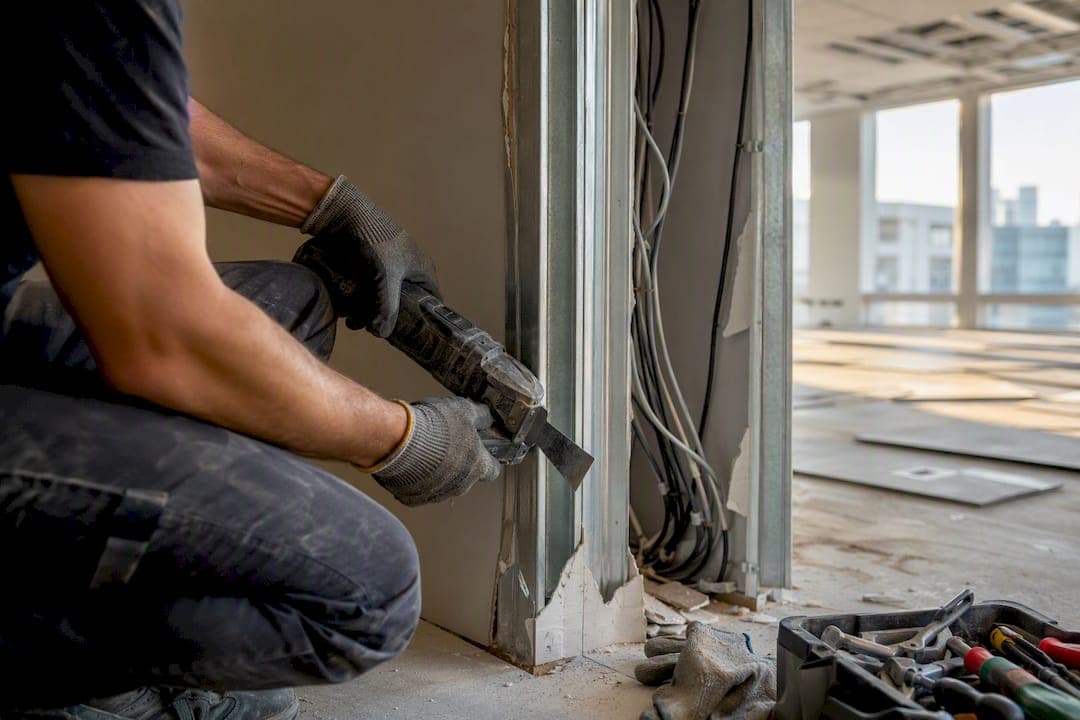
Partial reinstatement means restoring only a defined portion of an office, not the whole tenancy, back to a required condition. That could mean pulling down a temporary partition, patching flooring in one zone, or removing a signage panel from a single wall, rather than gutting the entire suite back to bare shell.
If that's the situation you're facing, three things need to happen right away:
- Locate your lease's reinstatement and alterations clauses and read them alongside any side letters or email approvals from the landlord.
- Document the current condition with dated, timestamped photos and a written inventory before anyone touches a wall or cable run.
- Get a scoped cost estimate from a contractor like Honest Builders so you know what you're working with before negotiating anything.
Reinstatement obligations are one of the most litigated corners of commercial leasing, and Practical Law's guidance on end-of-term restoration makes clear that liability rarely disappears just because you assumed it would. Restoration costs also vary widely by scope and condition, which is exactly why a scoped estimate beats a guess.
Key Takeaways
Partial reinstatement obligates the named tenant to restore only a defined portion of an office, and that duty survives assignment unless the lease says otherwise.
| Point | Details |
|---|---|
| Definition | Partial reinstatement restores a limited zone or scope, not the full premises, to a required condition. |
| Liability follows the lease | The original tenant usually stays responsible even after assigning or subletting the space. |
| Documentation prevents disputes | Dated photos and a written inventory before and after work protect against later landlord claims. |
| Lease clauses set the scope | Surrender, alterations, and landlord election clauses determine exactly what must come out. |
| Contractor support | Honest Builders provides scoped quotes, workmanship warranties, and handover-ready partial reinstatement work for commercial offices. |
Table of Contents
- What Is Partial Reinstatement of an Office, Exactly?
- Who Is Responsible: Tenant, Assignee, or Landlord?
- Lease Clauses That Decide the Scope
- What Partial Reinstatement Costs and Risks If You Skip It
- Your Step-by-Step Reinstatement Checklist
- How to Reduce Reinstatement Costs Through Negotiation
- When to Bring In a Contractor and What to Require
- What Most Reinstatement Guides Get Wrong
- Get a Scoped Quote for Your Office Reinstatement
- Frequently Asked Questions
- Sources
What Is Partial Reinstatement of an Office, Exactly?
Partial reinstatement covers a specific, limited set of works rather than a full make-good of the entire premises. It typically involves:
- Partition walls and glazing installed by the tenant in one area
- Suspended ceiling tiles or grids in the affected zone only
- Local flooring replacement or patching where carpet tile or vinyl was damaged or altered
- Removal of tenant signage or built-in joinery specific to that space
- Cabling and server rack removal limited to the reinstated footprint, not the whole floor
- Spot repairs to lighting fixtures and wall finishes
Picture three common scenarios. A single office suite gets divided between two tenants, and only one tenant's portion needs to be handed back. A subleased area requires the subtenant's improvements removed while the head tenant's base fit-out stays untouched. Or a landlord requests a phased handover, asking for specific rooms returned to base-building condition while the tenant continues occupying the rest during a notice period.
The difference from full reinstatement comes down to footprint and depth. A full make-good strips the unit back to base building, mechanical and electrical included. Partial reinstatement targets a smaller area with mostly cosmetic and localized M&E work, and reinstatement clauses generally expect tenant-installed fit-outs, including partitions, ceilings, flooring, signage, and cabling, to come out wherever the lease requires it.
Pro Tip: Walk the space with your lease in one hand and a tape measure in the other. Landlords often define "the affected area" loosely, and a five-foot miscalculation on where reinstatement starts and stops can cost you thousands.
Who Is Responsible: Tenant, Assignee, or Landlord?
Liability generally follows the lease, not the calendar or who happened to install the fit-out. The named tenant on the lease stays on the hook for reinstatement unless the document, or a separate agreement, expressly says otherwise.
This trips up a lot of businesses that assigned or subleased space years ago. Handing off occupancy doesn't hand off legal responsibility. Assignment does not automatically release the original tenant from restoration duties, a principle Practical Law spells out clearly for commercial leases. Even a tenant who never touched the build-out can inherit the obligation to remove it, because the duty attaches to the lease covenant, not to whoever swung the hammer.
Landlords also carry election rights. Many leases let the landlord choose to perform the reinstatement work themselves and bill the outgoing tenant afterward. A common pattern: the landlord commissions a contractor to strip out a partition wall the week after handover, then sends the former tenant an invoice, plus administrative fees, months later. That invoice is enforceable if the lease grants the landlord that election.
- The named tenant remains liable unless released in writing.
- Assignees inherit obligations tied to the space, not just the paperwork.
- Landlords can elect to do the work and recover costs afterward.
Lease Clauses That Decide the Scope
The actual scope of partial reinstatement lives in a handful of specific clauses, and most disputes trace back to someone skipping this step. Pull your lease and find:
- The surrender clause
- The alterations clause
- Tenant works consent provisions
- Cabling and data removal language
- Landlord election rights
- Holdover and penalty terms
- Any cap or cost-sharing provisions
Clause wording tends to fall into three camps. A tenant-friendly version reads close to "as is, where is," meaning the tenant hands back the space in its current condition with no removal obligation. A landlord-friendly version demands full restoration to original condition, often including anything installed before the tenant's own occupancy began. A compromise clause splits the difference: restore to good order except for specified landlord-retained items, which the landlord agrees in writing to keep.
Sample surrender provisions differ sharply depending on which party drafted them, and documented tenant-friendly, landlord-friendly, and compromise language shows how much negotiating room actually exists before a lease gets signed.
If your clause reads ambiguously, don't guess. Get legal advice and put any side agreement or landlord approval in writing, because a verbal "sure, leave that in" from three years ago won't hold up during a handover dispute.
What Partial Reinstatement Costs and Risks If You Skip It
Timing matters as much as money. Most leases set a reinstatement window within a few months before or after lease expiry, and landlords typically schedule a punch-list inspection right at handover. Miss that window and holdover rent can start accruing daily until the space passes inspection, sometimes at a rate well above your normal monthly rent.
Cost estimates vary considerably depending on scope. Published guidance on reinstatement work cites cost ranges tied directly to demolition complexity, disposal requirements, and mechanical or electrical scope, and hazardous material handling, think old ceiling tiles or wiring insulation, pushes costs toward the higher end fast. A simple partition removal and floor patch sits at the low end. A zone requiring cabling removal, ceiling grid replacement, and lighting rework climbs quickly.
If you don't complete the work, landlords have several remedies available:
- Carry out the reinstatement themselves and invoice you for the full cost
- Retain your security deposit against the shortfall
- Pursue a damages claim for unreinstated portions
- Charge holdover rent until the space is accepted back
None of these are theoretical. They're standard contractual tools most commercial leases build in explicitly.
Your Step-by-Step Reinstatement Checklist
Work through this sequence and you'll avoid the two most common failure points: missed deadlines and undocumented conditions.
- Review your lease and calendar every notice deadline tied to reinstatement.
- Get landlord approval in writing for anything you want to leave behind.
- Document the as-is condition with dated photos and a written inventory before work starts.
- Collect at least two contractor scopes and written estimates for comparison.
- Arrange permits and inspections if the work touches mechanical or electrical systems.
- Schedule a joint pre-handover inspection with the landlord or their representative.
- Secure a signed surrender agreement or written sign-off confirming completion.
At the pre-handover inspection, verify the essentials in the reinstated area: fresh photos matching the completed scope, lighting tested and functioning, cabling fully removed where required, and patch or paint work that actually blends with surrounding surfaces rather than standing out as an obvious repair.
Keep every invoice and warranty document in one folder. If a dispute surfaces six months later over a ceiling tile, that paperwork is your entire defense.* A signed surrender agreement with a mutual release closes the door on most late claims.

How to Reduce Reinstatement Costs Through Negotiation
You have more leverage before signing a renewal or exit agreement than after. A few tactics worth raising:
- Negotiate carve-outs for specific landlord-retained fixtures instead of blanket removal
- Cap total restoration liability by dollar amount or defined scope
- Propose a leave-in credit: you leave a valuable improvement, like upgraded lighting or a built-in reception desk, in exchange for a rent credit or a lower reinstatement cap
- Get landlord sign-off at the time of installation, not years later at exit, to prevent surprise removal demands
Whatever you agree to outside the standard lease language, put it in a signed side letter. A verbal understanding with a property manager who's since left the company is worth nothing during a handover dispute.
When to Bring In a Contractor and What to Require
Book contractors early, especially in busy renovation markets where good crews get scheduled weeks out. As a rule, start contractor conversations 60 to 90 days before your reinstatement deadline, and earlier still if the work touches specialist trades like electrical or data cabling.
Before signing anyone on, require:
- Proof of licensing where your jurisdiction requires it
- Public liability insurance, current and verifiable
- An itemized scope of work, not a vague one-line estimate
- A fixed-price quotation wherever the scope allows it
- Workmanship warranties in writing
- A clear disposal plan for any hazardous materials
- References from comparable reinstatement projects
Pro Tip: Ask every contractor for two references from jobs completed in the last six months, not two years ago. Crews change, and recent references tell you who's actually doing the work today. Honest Builders handles handover-ready partial reinstatement work across office, retail, and warehouse spaces, and provides written quotations and workmanship warranties as standard practice, worth using as a benchmark even if you shop other quotes first.
What Most Reinstatement Guides Get Wrong
Two lessons come up again and again in commercial reinstatement work. First, early documentation saves disputes, full stop. Tenants who photograph and inventory their space the week they move in, not the week they move out, have dramatically better leverage when a landlord tries to claim damage that predates their occupancy.
Second, get landlord sign-off in writing before you build anything you might want to leave behind. Verbal approval evaporates the moment the person who gave it changes jobs. Honest Builders has seen both patterns play out repeatedly across commercial reinstatement projects, and the businesses that come out ahead are almost never the ones with the fanciest fit-out. They're the ones with the paper trail.
Get a Scoped Quote for Your Office Reinstatement
Honest Builders is the practical alternative to piecing together your own crew of demolition, electrical, and flooring contractors for a partial reinstatement job. One team handles selective strip-out, M&E coordination, flooring and ceiling repair, and paint, then hands you the documentation your landlord actually wants to see at handover.

We work commercial spaces across offices, shops, and warehouses, and every project runs on the same two principles: show up, do the job right, and stand behind the work with no hidden charges and no runaround. If you're staring down a reinstatement deadline and need to know what it will actually cost before you commit to anything, request a scoped site visit and a no-obligation quote or WhatsApp us directly at +65 9447 9696.
Frequently Asked Questions
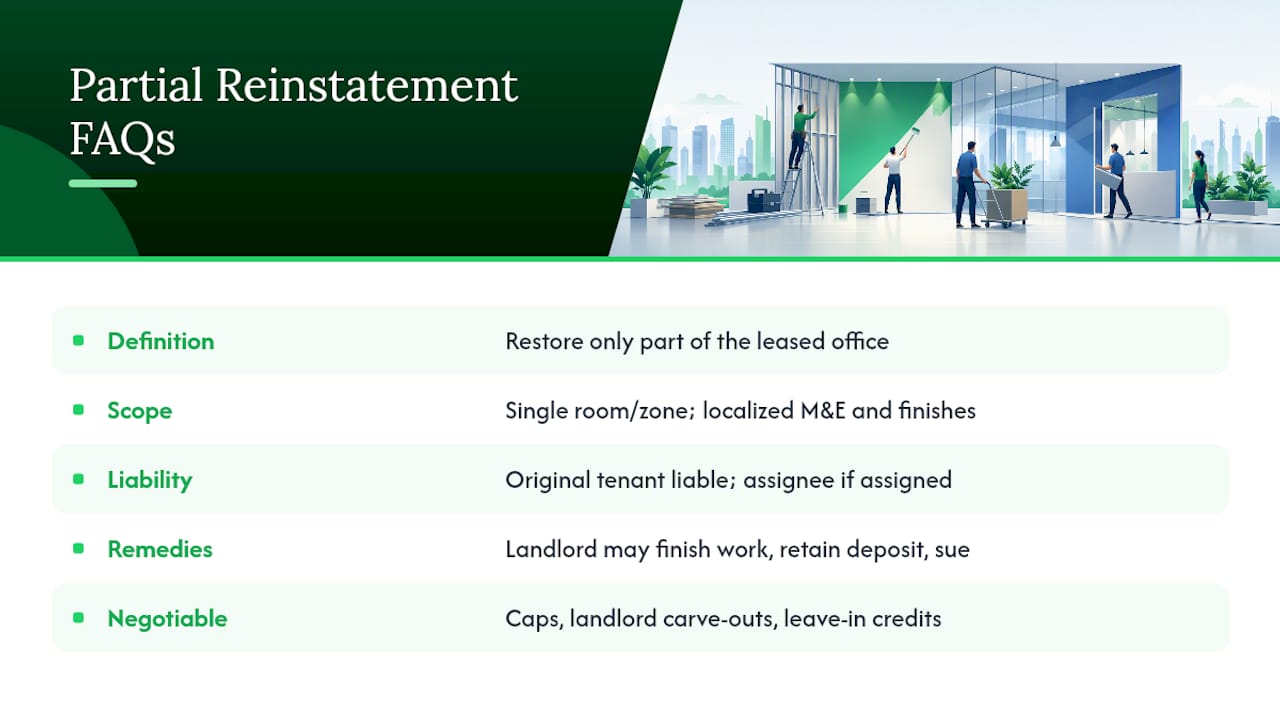
What is partial reinstatement in an office lease? Partial reinstatement is limited restoration work covering a specific portion of an office, such as one room or zone, rather than the entire leased premises. It typically includes removing tenant-installed partitions, patching flooring, and restoring finishes in that defined area only.
How is partial reinstatement different from full reinstatement? Full reinstatement returns the entire space to base-building condition, often including full mechanical and electrical strip-out. Partial reinstatement targets a smaller footprint with mostly cosmetic and localized M&E work.
Who pays for partial reinstatement if the tenant assigned the lease? The original tenant typically remains liable unless the lease or assignment agreement explicitly transfers or releases that obligation. Landlords can also pursue the assignee if the assignment document assigns the duty forward.
What happens if a tenant doesn't complete required reinstatement work? The landlord can carry out the work and invoice the tenant, retain the security deposit, pursue a damages claim, or charge holdover rent until the space passes inspection and is formally accepted back.
Can tenants negotiate partial reinstatement terms before signing a lease? Yes. Common negotiation points include capping restoration liability, securing carve-outs for landlord-retained fixtures, and arranging leave-in credits for valuable improvements in exchange for a rent credit or lower reinstatement obligation.
This article is general information, not a substitute for advice from a qualified lawyer. Consult a qualified legal professional about your own circumstances before acting on anything here.
Sources
- End-of-Lease Reinstatement Obligations: A Guide for Commercial Tenants
- End-of-Term Restoration | Practical Law
- Lease Restoration Clauses: Tenant Obligations Explained - LegalClarity
- Lease surrender and restoration clause commentary (Jenner & Block PDF)