
A commercial renovation contract is the written agreement that binds an owner or tenant and a contractor to a defined scope of work, a price, a schedule, and a clear allocation of risk. Before you sign anything, three items deserve your full attention: a precise, detailed scope of work; a written change-order process with signed approvals before work begins; and payment protections including lien waivers and retainage terms.
TL;DR — confirm these before signing:
- Scope of work references specific drawings, specs, and exclusions
- All change orders require written, signed approval before work starts
- Lien waivers are required at every payment milestone.
- Industry practice typically sets retainage at 5%–10% of progress payments until final acceptance and punch-list completion.
- An attorney has reviewed indemnity, termination, and insurance language
Table of Contents
- What does a commercial renovation contract actually cover?
- Key elements every commercial renovation contract must include
- What are the main types of commercial renovation contracts?
- Which contract clauses deserve the most scrutiny?
- How do you compare bids and negotiate contract terms?
- When should you get an attorney involved?
- Ambiguous scope and change orders drive most renovation disputes
- Key Takeaways
- The contract is a project playbook, not just paperwork
- Useful sources and primary references for further reading
What does a commercial renovation contract actually cover?
A commercial renovation contract names the parties (typically an owner or tenant and a general contractor), describes the deliverables in detail, sets the price and payment schedule, establishes a project timeline, and allocates legal and financial risk between the two sides. It is a binding legal document, not a proposal or a handshake.
Commercial contracts are almost always longer and more detailed than residential ones. The reasons are practical: commercial projects involve code compliance across multiple trades, multiple stakeholders (lenders, landlords, local authorities), higher dollar values, and greater liability exposure on both sides. A residential remodel might run two or three pages; a commercial renovation agreement for an office fit-out or retail build-out can run 30 pages or more, with attached drawings, specifications, and schedules.
The contractor typically drafts the first version, often using a standard form such as an AIA contract document or a government-issued template. That first draft almost always favors the contractor. An attorney representing the owner should review it before execution, and negotiation is both expected and normal.
Key elements every commercial renovation contract must include
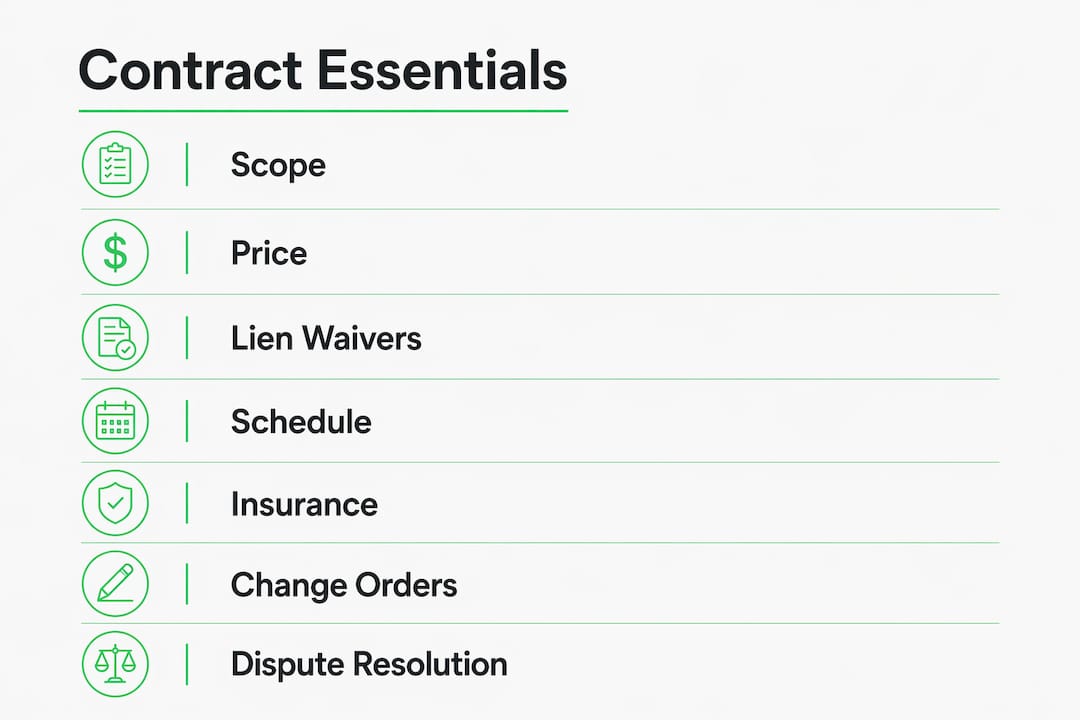
A contract that omits any of the items below creates a gap that will cost you money or time, usually both.
Scope of work
The scope section is the most important part of the document. It should reference attached drawings and specifications by name and revision date, list specific materials and finishes, and explicitly state what is excluded. Vague phrases like "standard work" or "as directed" are the leading root cause of renovation disputes. If it is not written down with specificity, it is not an enforceable term. For projects involving mechanical and electrical systems, those scopes need their own detailed callouts in the contract drawings.

Price, payment schedule, and retainage
The contract must state the total price, the payment trigger (milestone completion, monthly draw, or percentage of completion), and the retainage amount. Industry practice sets retainage at a modest percentage of each progress payment, held until final acceptance and punch-list completion. Retainage is your primary financial lever for ensuring quality at the end of the job. A well-structured milestone payment schedule ties each draw to a verifiable deliverable, not just a calendar date.

Lien waivers
Require the contractor to provide a conditional lien waiver with each draw request and a final unconditional lien waiver before you release the final payment. Without these, subcontractors and suppliers the contractor has not paid can file mechanic's liens against your property even after you have paid the contractor in full.
Schedule and milestones
The contract should include a project schedule with named milestones, a substantial completion date, and a defined punch-list acceptance process. "Completion" needs a written definition. Substantial completion (the point at which the space is usable for its intended purpose) and final completion (all punch-list items resolved) are two different legal thresholds with different payment consequences.
Insurance, bonds, permits, and warranties
Specify minimum insurance limits (general liability, workers' compensation, builder's risk), who carries each policy, and whether the owner needs to be named as an additional insured. Identify who pulls the permits. Warranty terms should state duration separately for workmanship and materials; one year for workmanship is a common floor, but negotiate longer for major systems.
Change order procedure
Every change to scope, price, or schedule must follow a written process. The contract should define who can authorize a change order, the required form, the timeline for pricing and approval, and the consequence of proceeding without authorization (the contractor does not get paid).
Dispute resolution, termination, and indemnity
State whether disputes go to arbitration or litigation, and in which jurisdiction. Termination clauses should cover both termination for cause and termination for convenience, with defined notice and cure periods. Indemnity language should be mutual and capped where possible.
Pro Tip: Ask the contractor to highlight every instance of "as directed," "owner's discretion," or "standard practice" in their draft. Each one is a potential dispute waiting to happen. Replace them with specific, measurable language before you sign.
| Contract Element | What to Verify |
|---|---|
| Scope of work | References drawings/specs by name; exclusions listed explicitly |
| Price and payment | Milestone triggers defined; retainage 5%–10% stated |
| Lien waivers | Required at each draw and at final payment |
| Schedule | Milestones named; substantial vs. final completion defined |
| Change orders | Written, signed approval required before work begins |
| Insurance | Limits specified; owner named as additional insured |
| Warranties | Duration stated for workmanship and materials separately |
| Dispute resolution | Forum and jurisdiction named |
What are the main types of commercial renovation contracts?
Contract type determines who absorbs cost risk when conditions change. Choosing the wrong model for your project stage is one of the most expensive mistakes an owner can make.
Lump sum (fixed price): One price covers the full defined scope. The contractor absorbs cost overruns; the owner gets budget certainty. The catch is that this protection only holds if the scope is fully defined upfront. Incomplete drawings or vague specs will generate change orders that erode the fixed price quickly. Lenders and draw schedules often require a firm contract sum, which pushes many financed projects toward lump-sum or GMP arrangements.
Cost-plus: The owner reimburses actual costs (labor, materials, subcontractors) plus a contractor fee, either fixed or percentage-based. Owners carry the financial exposure and must actively review pay applications, receipts, and subcontractor invoices. Without that oversight, costs can outpace the budget with no contractual ceiling.
Guaranteed maximum price (GMP): A hybrid. The owner pays actual costs up to a stated cap; the contractor absorbs anything above it. GMP gives owners a cost ceiling while allowing some flexibility in scope development. It works well when design is partially complete but not fully resolved.
Time and materials / unit price: The owner pays for actual hours and materials at agreed rates. Unit price contracts set a price per measurable unit of work (square feet of tile, linear feet of duct). Both models suit smaller scopes or work where quantities are genuinely uncertain.
Design-build: A single entity handles both design and construction under one contract. The owner gets a single point of accountability and often a faster schedule, but gives up some control over design decisions and independent design review.
IPD (Integrated Project Delivery) / incentive models: All major parties share risk and reward against a target cost. Used on large, complex projects where collaboration across owner, designer, and contractor is critical. Rare on standard commercial renovations.
| Contract Type | Price Certainty | Who Carries Concealed-Condition Risk | Best For | Typical Payment Structure |
|---|---|---|---|---|
| Lump sum | High | Contractor (if scope is complete) | Design-complete projects | Milestone draws |
| Cost-plus | Low | Owner | Early-stage or phased work | Monthly cost reimbursement + fee |
| GMP | Medium-high | Shared up to cap, contractor above | Partially designed projects | Cost reimbursement up to cap |
| Time and materials | Low | Owner | Small scopes, uncertain quantities | Hourly/unit rates |
| Design-build | Medium | Contractor | Fast-track, single-source delivery | Milestone or lump sum |
| IPD/incentive | Shared | Shared | Large, complex, collaborative projects | Target cost with shared savings |
Which contract clauses deserve the most scrutiny?
Most disputes in commercial renovation trace back to a small set of clauses. Read these carefully and push back on language that leaves you exposed.
Change orders. The contract must require written, signed change orders before any out-of-scope work begins. Verbal authorizations are routinely unenforceable. A contractor who proceeds without a signed change order takes the risk of non-payment; an owner who verbally approves work and then disputes the cost is in a weak position. The clause should also define the timeline for pricing a proposed change (10 business days is common) and what happens to the schedule when a change is approved.
Liquidated damages. If the contractor misses the completion date, liquidated damages (LD) clauses specify a daily dollar amount the contractor owes the owner. These must be a genuine pre-estimate of your actual losses, not a penalty. Negotiate the daily rate against your real carrying costs: rent, lost revenue, or holding costs.
Indemnity and hold-harmless language. Broad, one-sided indemnity clauses can require you to defend and indemnify the contractor for claims arising from the contractor's own negligence. Push for mutual indemnity limited to each party's own acts or omissions, and cap total indemnity exposure where possible.
Lien waivers. As noted in the elements section, conditional lien waivers at each draw and a final unconditional waiver before final payment are non-negotiable protections for your title.
Warranty scope and duration. Confirm that the warranty covers both workmanship and materials, names who is responsible for warranty claims (the GC, not just the subcontractor), and specifies the process for submitting a warranty claim.
Termination clauses. When a contract includes termination-for-cause or termination-for-convenience clauses, both parties must comply strictly with notice, cure, and documentation requirements. Exercising termination incorrectly can expose you to a wrongful-termination claim. Termination for convenience (ending the contract without cause) typically requires payment for work completed plus a defined wind-down fee.
Red-flag language to strike or rewrite before signing: "Work shall be performed as directed by the owner" (no written approval required) "Contractor may proceed with changes pending written confirmation" (verbal authorization implied) "Owner shall indemnify contractor for all claims arising from the project" (one-sided, uncapped indemnity) "Disputes shall be resolved in contractor's home jurisdiction" (inconvenient forum for owner) "Warranty limited to defects reported within 30 days of completion" (unreasonably short window)
How do you compare bids and negotiate contract terms?
Comparing bids on price alone is how owners end up with the wrong contractor. A lower number on the cover page often means a narrower scope, higher allowances, or missing line items that will reappear as change orders.
Bid comparison checklist:
- Confirm each bid covers an identical scope. Ask each contractor to mark what is included and excluded.
- Check allowance amounts. A bid with a $5,000 flooring allowance against a $15,000 allowance in another bid is not an apples-to-apples comparison.
- Verify contingency line items. A contractor who includes no contingency is either very confident or hiding future change orders.
- Confirm the proposed schedule aligns with your operational timeline.
- Check insurance certificates and bonding capacity before shortlisting.
- Call at least two references from projects of similar type and scale.
For a deeper look at how bid breakdowns work and what to ask for in a proposal, construction bid guides walk through the line-item structure in detail.
Negotiation checklist (numbered for use in meetings):
- Ask the contractor to walk through every exclusion in their scope section line by line.
- Request a written change-order form and confirm the approval workflow before signing.
- Ask how subcontractors are selected and whether you have approval rights over key subs.
- Confirm the retainage percentage and the release conditions.
- Ask what documentation they provide with each draw request (receipts, subcontractor invoices, lien waivers).
- Negotiate the liquidated damages rate against your real carrying costs.
- Ask for a redline of any clause you want changed; professional contractors expect it.
Red flags that should prompt you to walk away or escalate to counsel:
- Contractor refuses to provide lien waivers or resists the concept
- No physical business address on the contract
- Pressure to sign before drawings or specs are finalized
- Change-order language that allows the contractor to proceed verbally
- Warranty limited to 30 days or tied only to manufacturer warranties
- Single contract signed by an individual, not a company representative
When should you get an attorney involved?
For any commercial renovation above a modest dollar threshold, legal review is not optional. The contract is a risk-allocation document, and the first draft almost always allocates more risk to you than it should.
Situations that always warrant counsel:
- GMP or cost-plus contracts (complex cost-reporting obligations)
- Multi-site rollouts or phased projects with multiple contract packages
- Projects where the contractor is providing design services (design-build)
- Any contract with complex warranty, indemnity, or insurance requirements
- Projects where financing is involved and the lender has contract requirements
What a lawyer will check:
- Ambiguous scope language and undefined terms
- Change-order controls and notice requirements
- Indemnity caps and mutual vs. one-sided language
- Insurance endorsements and additional-insured requirements
- Lien waiver language and mechanic's lien exposure
- Dispute resolution forum and governing law
- Termination notice periods and cure rights
- Retainage release conditions
The typical deliverable from a contract review is a redlined draft with a short negotiation memo explaining which changes are critical, which are negotiable, and which are standard. Expect the attorney to suggest specific replacement clause language, not just flag problems. That memo becomes your negotiating script.
This article is general information, not legal advice. Confirm current requirements with a licensed attorney in your jurisdiction before signing any commercial contract.
Ambiguous scope and change orders drive most renovation disputes
Legal reviewers consistently identify vague scope language and missing written change-order controls as the primary drivers of commercial renovation litigation. Phrases like "standard work" or "as directed" create interpretive gaps that contractors and owners fill differently, and those gaps become disputes.
Key insight: Attorneys who review renovation contracts report that the majority of costly disputes trace directly to two contract failures: scope language that does not reference specific drawings or specs, and change-order processes that allow verbal authorizations.
The fix is straightforward, but it requires discipline at the drafting stage:
- Attach all drawings and specifications to the contract as named exhibits, referenced by revision date
- Include a clause that reads: "No verbal change orders. All changes to scope, price, or schedule require a written change order signed by both parties before work begins."
- Define a cost threshold that automatically triggers the formal change-order process
- Require the contractor to submit a written change-order request within a defined number of days of discovering a condition that may require additional work
- State explicitly that the contractor will not be compensated for work performed without a duly executed change order
These controls do not just protect your budget. They reallocate risk to the party best positioned to manage it: the contractor controls the work, so the contractor bears the cost of proceeding without authorization. Owners who enforce written change-order discipline also tend to have better relationships with contractors, because expectations are clear on both sides.
Key Takeaways
A commercial renovation contract protects your budget, your timeline, and your property title only when scope, change orders, and payment terms are written with specificity and enforced consistently.
| Point | Details |
|---|---|
| Scope must be specific | Attach drawings and specs as named exhibits; strike vague phrases like "standard work." |
| Change orders in writing | Require signed approval before work begins; verbal authorizations are routinely unenforceable. |
| Lien waivers at every draw | Conditional waivers with each payment, final unconditional waiver before the last draw. |
| Retainage is your leverage | Industry practice sets retainage at 5%–10% of progress payments until punch-list acceptance. |
| Get legal review | An attorney's redline is worth the cost on any GMP, design-build, or financed project. |
The contract is a project playbook, not just paperwork
Most business owners treat the contract as a formality to get through before the real work starts. That framing is expensive. The contract is the only document that defines what "done" means, who pays when something goes wrong, and what happens if the relationship breaks down. Skimping on it to save time or avoid friction with a contractor you like is a false economy.
The practical reality is that well-negotiated contracts actually improve contractor relationships. Reputable contractors expect negotiation. They have seen the disputes that vague language creates, and most of them would rather have a clear document than a contentious project. If a contractor resists written change orders or pushes back on lien waivers, that resistance tells you something important about how they operate.
The one rule I would give any business owner going into a commercial renovation: treat the contract as a risk-allocation tool, not a trust document. Assign each risk to the party best positioned to control it. Permits go to the contractor. Site-condition risk gets defined and allocated explicitly. Insurance requirements get verified before the first tool arrives on site. The contract does not replace trust; it makes trust unnecessary for the things that can be written down.
Useful sources and primary references for further reading
These are the highest-value sources for owners and project managers who want to go deeper on specific contract topics.
-
AIA Contract Documents: The American Institute of Architects publishes the most widely used standard form construction contracts in the U.S. (A101, A102, A133, and others). Use these as a baseline when evaluating a contractor's custom form or drafting your own. Consult before any project above a modest scale.
-
Lake County, FL Sample Commercial Contract: A real government-issued commercial tenant improvement contract with detailed change-order, retainage, and payment provisions. Useful as a reference for what a well-structured public-sector contract looks like, including the specific language for change-order approval workflows.
-
Daeryun Law — Remodeling Contract in NYC: Attorney-authored analysis of the most common contract pitfalls, with specific focus on scope language, change-order controls, and lien waivers. Consult this when reviewing indemnity and lien provisions.
-
Diamond Contractors — Commercial Construction Contract Guide: Practical contractor-side explanation of what goes into a commercial contract, including retainage norms and payment scheduling. Useful for understanding how contractors structure their proposals.
-
EB3 Construction — Cost-Plus vs. Fixed-Price: Clear explanation of the trade-offs between contract types, with guidance on when each model fits. Read this before choosing a contract structure for your project.
-
Harris Constructors — Renovation Contract Sample Guide: Template-level overview of what a renovation contract should include, with a red-flag checklist for phrase-level issues. Good starting point for owners reviewing a contractor's first draft.
-
Antham Group — 10 Items to Look for in a Commercial Renovation Contract: A concise practical checklist covering payment schedules, dispute resolution, timeline, and contractor verification. Use it as a quick pre-signing scan alongside your attorney's redline.
For commercial renovation projects in Singapore, Honestbuilders provides transparent, no-hidden-charges commercial renovation services for shops, warehouses, and offices, with clear written scopes and accountable project management from day one.