What are the key steps in a commercial electrical upgrade?
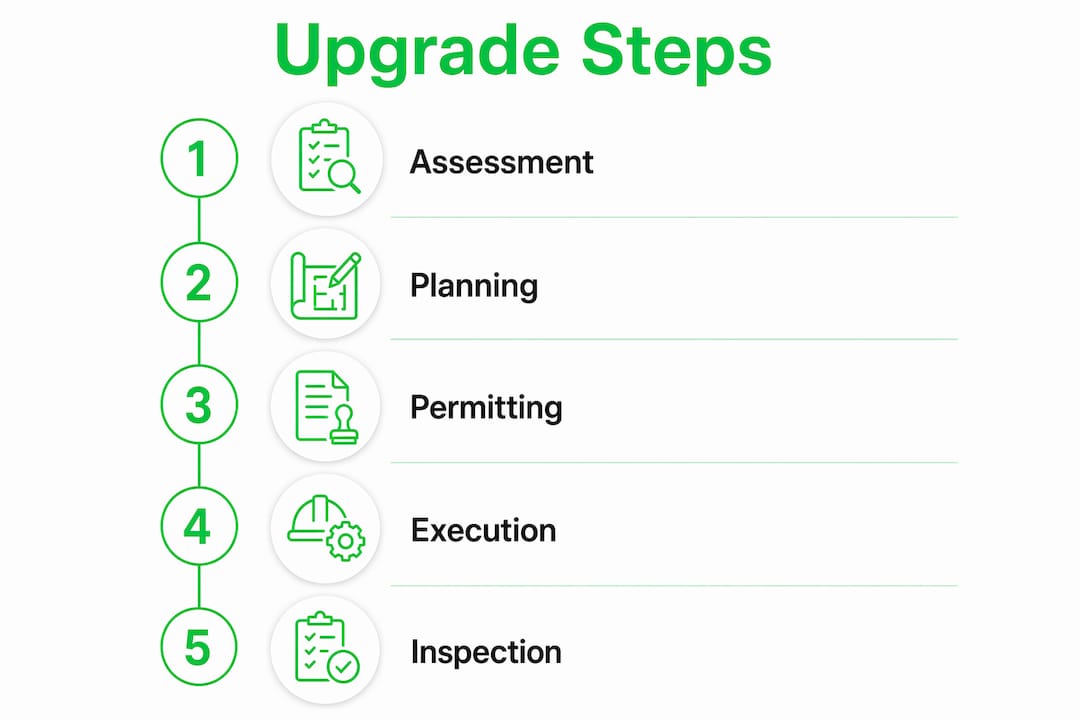
A commercial electrical upgrade follows a clear sequence, and skipping any step creates real problems down the line. Here is the core process, at a glance:
- Assess the current system and calculate future electrical demands
- Run load calculations per NEC Article 220 to size the new service correctly
- Develop an upgrade plan that balances capacity, compliance, and budget
- Hire a licensed electrical contractor with commercial experience
- Pull permits through your contractor before any work begins
- Coordinate with your utility provider early, since utility scheduling often drives the overall timeline
- Execute the panel or full service upgrade with power safely shut off
- Pass final inspection from the Authority Having Jurisdiction (AHJ)
- Plan for downtime and have continuity measures ready for critical operations
Two upgrade types exist: a panel upgrade that improves internal distribution without changing service size, and a full service upgrade that increases total electrical capacity and requires utility coordination. Knowing which one you need before you call a contractor saves weeks of back-and-forth.
Why upgrading your commercial electrical system matters

Code compliance alone is reason enough for most facility managers. The National Electrical Code (NEC) updates regularly, and systems that passed inspection 20 years ago often fall short of current standards, sometimes requiring a full overhaul rather than a simple fix.
Beyond compliance, aging infrastructure creates daily operational risk. Frequent breaker trips, flickering lights, and overloaded circuits are not just annoyances. They signal that your system is running at or beyond its safe limit, raising fire risk and liability exposure.
- NEC compliance: Updated NEC standards may require full system overhauls, not just minor repairs
- Aging equipment: Panels and wiring older than 25 years typically need replacement
- New load demands: EV chargers, HVAC upgrades, and high-draw equipment push older panels past capacity
- Energy efficiency: Modern panels and wiring support better load management and reduced waste
- Workplace safety: Outdated systems increase arc flash and fire risk, directly affecting liability
Pre-planning and load calculations following NEC standards underpin safe, cost-effective, and code-compliant upgrades. Getting that right at the start prevents expensive rework later.
How do you know your commercial panel needs an upgrade?
Some warning signs are obvious. Others show up gradually until a breaker finally fails during peak hours. Watch for these:
- Frequent breaker trips under normal operating loads, not just during heavy use
- Outdated panel brands such as Federal Pacific Stab-Lok or Zinsco, which are known for breakers that weld shut and melted bus bars
- Flickering or dimming lights when large equipment cycles on
- New major equipment like Level 2 EV chargers or commercial HVAC that exceeds current panel capacity
- Panels or wiring older than 25 years, which likely predate current NEC requirements
- Insufficient circuit space for planned expansions, or circuits with missing or inaccurate labels
A Zinsco panel, for example, was discontinued after GTE-Sylvania acquired the brand in the early 1970s. If your building still has one, replacement is not optional. The same applies to Federal Pacific Stab-Lok panels, where breakers are documented to fail under load.
Planning and assessment before the upgrade begins
Good planning is what separates a smooth upgrade from a project that runs over budget and drags on for months. Start here before you contact a single contractor.
- Load calculation per NEC Article 220: Failing to assess total connected load leads to over-specified panels that cannot be fully utilized because the feeder or transformer cannot support them
- Equipment inventory: List every current electrical load and every planned addition, including future EV chargers, HVAC units, or production equipment
- Panel and wiring condition review: Evaluate whether existing wiring, grounding, and panel condition meet current code or require replacement
- Utility capacity verification: Contact your utility provider early to confirm whether the service entrance and transformer can support the increased load
- Budget estimate: Include materials, labor, permit fees at typical jurisdictional rates, utility coordination, and a contingency for unexpected conditions
- Downtime planning: Identify mission-critical systems, plan temporary power where needed, and schedule work during off-peak hours
Pro Tip: If your utility feed or transformer is undersized, upgrading the panel alone will not increase usable capacity. Verify service entrance capacity before finalizing your upgrade scope, or you will pay for a panel that cannot deliver what you need.
For a broader look at how electrical work fits into a full commercial project, the M&E works planning guide covers critical coordination steps that apply directly here.
How to hire the right electrical contractor
The contractor you choose determines whether your upgrade passes inspection the first time or gets flagged for rework. License and experience are the baseline, not a bonus.
- Verify licensing and insurance: Most US jurisdictions require licensed electricians to pull electrical permits. Owners cannot pull service permits themselves in most states, and doing so creates liability and insurance problems
- Look for commercial NEC experience: A contractor who primarily does residential work may not be familiar with commercial load calculations or three-phase systems
- Get 2–3 detailed quotes: The spread between quotes tells you whether the scope is consistent. A suspiciously low bid usually means something is being left out
- Confirm permit responsibility: Your contractor should pull the permit in their own name and manage the inspection process
- Ask about utility coordination: Some smaller shops push utility scheduling onto the building owner. You want a contractor who handles it directly
- Check references for similar projects: Ask specifically about commercial upgrades, not just residential panel swaps
Pro Tip: If a contractor suggests skipping the permit to save money, walk away. That shortcut will surface during your next property sale, insurance claim, or inspection, and the cost of forced rework far exceeds any permit fee.
For guidance on commercial electrical services and what a well-managed upgrade engagement looks like, reviewing a specialist checklist before your first contractor call is worth the time.
Permits, inspections, and staying code-compliant
Permits are not bureaucratic overhead. They are what keep your insurance valid and your building legally occupiable.
- Permits are mandatory: Licensed electricians must pull the permit in their name. Unauthorized permit pulling by owners risks fines, insurance loss, or forced rework
- NEC compliance is the standard: All work must meet the current National Electrical Code, which inspectors use as their benchmark
- Inspections cover the details: Grounding, wire sizing, circuit labeling, breaker function, and arc fault protection all get checked
- Permit fees are predictable: Fees typically run $75–$200 depending on the jurisdiction, a small cost relative to the protection they provide
- Non-compliance consequences are serious: Skipped permits can invalidate property insurance, trigger fines, and require complete rework at the owner's expense
- Schedule inspections early: Inspection availability varies by city. In some jurisdictions, same-day inspection is possible; in others, you wait days. Build that into your timeline from the start
Step-by-step: how the upgrade actually gets executed
The physical work moves faster than most facility managers expect. What takes time is everything around it.
- Utility power cutoff: The utility disconnects the meter or cuts the drop at the weatherhead. No work begins until power is confirmed off.
- Old panel disconnection: Service entrance conductors are removed from the meter base and panel. Every branch circuit gets labeled before disconnection.
- Old panel removal: The existing panel comes off the wall. This is also when any corroded service mast or weatherhead gets replaced if needed.
- New panel installation: The new panel, main breaker, and bus bars go in. Service entrance conductors are connected to the new meter base.
- Grounding system installation: Two ground rods are driven into the earth, plus a bond to the cold water main if it is metal. NEC 250.50 and 250.52 define what qualifies.
- Circuit reconnection and labeling: Each branch circuit connects to its new breaker. Accurate labeling here prevents future troubleshooting headaches.
- Final inspection: A municipal or third-party inspector reviews grounding, wire sizing, labeling, and breaker function. The utility will not reconnect until the inspector issues a green tag.
- Utility meter reinstallation: The utility reinstalls the meter and restores power, typically within one day of inspection approval.
- Post-installation testing: Every circuit gets tested. Any issues get corrected before the project is closed out.
The physical panel swap takes several hours of power-off time. The full project duration, from permit application to final utility reconnection, varies widely depending on permit turnaround and utility scheduling. Non-electrical factors, including municipal permitting and utility backlogs, drive the timeline far more than the physical installation itself.
For strategies on keeping operations running during major electrical work, the warehouse refurbishment guide covers phased installation and temporary power approaches that apply directly to commercial upgrades.
What does a commercial electrical upgrade actually cost?
Costs vary significantly based on upgrade type, building complexity, and local utility requirements.
- Panel upgrade (100A to 200A residential equivalent): Typically $1,800–$3,500, including the new panel, main breaker, service entrance conductors, meter base, ground rods, permit, and utility reconnect
- Full service upgrade (200A to 400A or higher): Runs $4,500–$8,000, sometimes more when the utility needs to upsize the transformer or service drop
- Commercial costs vary further: Three-phase systems, higher voltage requirements, and larger facilities push costs well above residential benchmarks
- Permit and inspection fees: $75–$200 per jurisdiction, a fixed and predictable line item
- Additional costs to budget for: Meter relocation, drywall repair after panel repositioning ($150–$600), service mast replacement ($300–$900), and subpanel additions ($500–$1,500 plus feeder wire)
- Utility infrastructure upgrades: If the utility needs to upgrade the transformer or service drop, that cost is outside the contractor's scope and can add significantly to the total
- Contingency: Budget at least 10–15% above your estimate for unexpected conditions, particularly in older buildings where wiring condition is unknown until walls are opened
The panel hardware itself is a small fraction of the total cost. Labor and utility coordination drive the bulk of expenses, which is why contractor selection and early utility engagement matter so much to the final number. For a full breakdown of how to structure your project budget, the commercial renovation budget guide covers cost allocation methods that apply directly to electrical upgrade planning.
Ready to plan your commercial electrical upgrade?

Honestbuilders handles commercial renovation projects with the same standard on every job: show up, do it right, and stand behind the work. Whether you need electrical planning as part of a broader commercial fit-out or a standalone system upgrade, the team at Honestbuilders delivers with no hidden charges and no runaround. WhatsApp +65 9447 9696 for a free, no-obligation quote.
Key Takeaways
A commercial electrical upgrade done right starts with NEC-compliant load calculations, a licensed contractor pulling permits, and early utility coordination to prevent delays that can extend the project timeline significantly.
| Point | Details |
|---|---|
| Two upgrade types exist | A panel upgrade improves internal distribution; a full service upgrade increases total capacity and requires utility coordination. |
| Timeline is permit-driven | Physical installation typically takes several hours, but the overall project duration extends 4 to 14 weeks due to permit turnaround, inspections, and utility scheduling. |
| Permits require a licensed contractor | Most US jurisdictions prohibit owners from pulling electrical permits; the contractor must pull in their own name. |
| Cost range varies by scope | A 100A to 200A upgrade runs $1,800–$3,500; a 200A to 400A service upgrade runs $4,500–$8,000 or more. |
| Service entrance must be verified | Upgrading the panel without confirming transformer and feeder capacity risks an underutilized system that cannot deliver the increased load. |