
Electrical reinstatement means restoring or reconnecting wiring, circuits, outlets, switches, fixtures, and panels as part of a renovation, demolition (hacking), or damage repair. It is the formal term contractors and code officials use when electrical systems must be brought back to a safe, code-compliant, and fully operational state after they have been disturbed or removed. Before any work starts, take these three steps right now:
- Commission a site survey and get a written scope of work (SOW) that names every deliverable.
- Require complete panel schedules and a sleeve coordination drawing before any slab is poured.
- Confirm the contractor will pull permits, use a licensed electrician, and provide inspection sign-offs as contract deliverables.
Those three requirements alone eliminate the majority of costly surprises. Timing the electrical rough-in while walls are already open during demolition also cuts labor and patching costs significantly, per Schafer Electric's project guidance.
Table of Contents
- What does an electrical reinstatement scope actually cover?
- Common omissions that drive the biggest cost overruns
- How long does electrical reinstatement take, and what drives the cost?
- Questions to ask contractors before you award the job
- Sample SOW snippet and panel schedule you can adapt
- Key Takeaways
- Why detailed SOWs are the real protection on reinstatement jobs
- Honestbuilders can handle your electrical reinstatement from survey to sign-off
- Useful sources and standards
What does an electrical reinstatement scope actually cover?
A complete electrical SOW must address five distinct areas, according to Provision's electrical scope-of-work guide. Missing even one of them is how change orders start.
1. Service and distribution. This covers the utility meter, service entrance conductors, main disconnect, and the main panelboard or switchboard. Deliverables include service size confirmation, bus type, and utility coordination letters for any service upgrade.
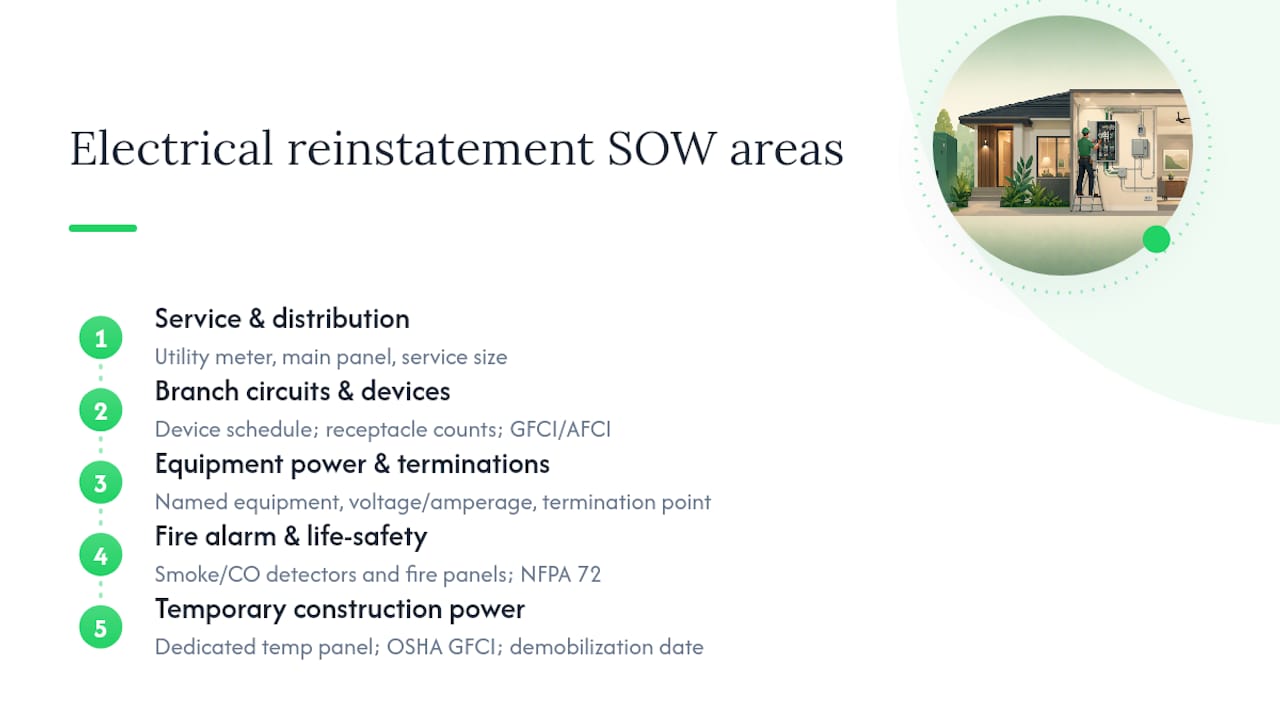
2. Branch circuits and devices. Every circuit run from the panel to outlets, switches, and fixtures belongs here. The sub must provide a device schedule listing receptacle types, counts by room, and GFCI/AFCI locations per NEC Articles 210.8 and 210.12.
3. Equipment power and terminations. Dedicated circuits for HVAC, appliances, EV chargers, and any specialty equipment. The SOW must name each piece of equipment, its voltage and amperage, and the termination point the electrician is responsible for.
4. Fire alarm and life-safety interfaces. Any work touching smoke detectors, carbon monoxide alarms, or fire alarm panels falls under NFPA 72. Reinstatement after a renovation must restore these systems to full operation before occupancy.
5. Temporary construction power. This is the most frequently omitted area. The sub needs a dedicated temporary service panel, GFCI protection per OSHA 1926.404(b)(1)(ii), and a clear demobilization date. Without a separate line item, most subs simply exclude it.
For commercial projects, the M&E coordination requirements add another layer: the electrical sub must coordinate sleeve locations with mechanical and plumbing trades before structural pours happen.
It is also worth knowing where restoration sits relative to renovation and remodel. Exquisite Electric explains that restoration prioritizes preserving historic fixtures and character while upgrading the wiring behind them, such as replacing knob-and-tube wiring without disturbing original light fixtures. If your project involves an older property, define in the SOW whether the scope is restoration (preserve visible elements, upgrade wiring) or remodel (rewire to support a new layout), because bidders price them differently.
Common omissions that drive the biggest cost overruns
Every item below is predictable. Require the fix in the contract before you award.
- Sleeves and conduit penetrations through slabs — Once a slab is poured, the only remedy is core drilling, and post-tensioned slabs may need an engineering review before anyone drills. The fix: require a signed sleeve coordination drawing before each pour and make sleeve installation the electrical sub's explicit responsibility, per Provision's guidance.
Pro Tip: Require milestone-based material release dates in the contract, not just installation dates. Long equipment lead times mean subs must release gear shortly after award to hit energization targets. If release dates are not in the contract, the schedule slips without anyone being contractually responsible.
How long does electrical reinstatement take, and what drives the cost?
For an average 1,500–2,500 sq ft home with walls already open during renovation, the electrical portion typically runs 2–4 weeks, not counting drywall repair. Commercial projects vary widely based on service size and equipment complexity.
Schedule milestones to require in the contract
| Milestone | Typical Timing from Award |
|---|---|
| Site survey complete | Week 1 |
| Shop drawings submitted | Week 2–3 |
| Material release (panelboards, ATS) | Week 2–4 |
| Rough-in complete | Week 4–8 |
| Panel energization | Week 6–8 |
| Commissioning and witness testing | Week 8–10 |
| Final inspection and sign-off | Week 9–11 |
Equipment lead times are the most common schedule killer. Panelboards and switchboards can run 8–20 weeks from order to delivery. Automatic transfer switches (ATS) and motor control centers (MCCs) often run longer. Require submittal and release dates in the SOW, not just installation dates, so the sub is contractually obligated to order gear on time.
Main cost drivers: retrofitted slab penetrations (core drilling is expensive), temporary power provision, equipment customization, commissioning labor, and site-access constraints that slow rough-in.
Questions to ask contractors before you award the job
- Can you provide a complete panel schedule for every panelboard at bid stage?
- Who is responsible for sleeve installation, and will you provide a signed sleeve coordination drawing before each pour?
- What is your licensed electrician's license number and state of issue?
- What are your firm lead-time commitments for panelboards and specialty equipment?
- Is temporary construction power included as a separate line item in your bid?
- Will you provide commissioning staffing and witness testing as a named deliverable?
- Can you show a sample submittal package from a comparable project?
Red flags: vague panel counts ("circuits TBD"), "supply on backorder" with no named alternative, refusal to include sleeve coordination or commissioning in the SOW, and any pressure to skip permits. If a bidder cannot produce a panel schedule at bid stage, they have not priced the job properly. Walk away or require a revised bid before awarding.
Sample SOW snippet and panel schedule you can adapt
Short SOW snippet
Electrical Reinstatement Scope — [Project Name] Contractor shall furnish all labor, materials, and equipment to reinstate the electrical systems as described below. Scope includes: (1) service entrance and main panel replacement per attached panel schedule; (2) all branch circuits, devices, and grounding per NEC Article 250; (3) GFCI/AFCI protection per NEC 210.8 and 210.12; (4) temporary construction power with GFCI per OSHA 1926.404; (5) sleeve installation per signed sleeve coordination drawing prior to each pour; (6) commissioning, energization, and witness testing. Contractor shall obtain all permits and deliver inspection sign-offs before final payment. Material release by [Date]. Commissioning complete by [Date].
Sample panel schedule (adapt circuit labels to your project)
| Circuit # | Breaker Size | Load Description | Notes |
|---|---|---|---|
| 1 | 20A | Kitchen receptacles (GFCI) | NEC 210.8 |
| 2 | 20A | Kitchen receptacles (GFCI) | NEC 210.8 |
| 3 | — | Master bedroom (AFCI) | NEC 210.12 |
| 4 | — | Living room (AFCI) | NEC 210.12 |
| 5 | — | Dryer | Dedicated |
| 6 | 20A | Bathroom (GFCI) | NEC 210.8 |
| 7–9 | — | Spare capacity | Label at install |
Required attachments checklist
- Signed sleeve coordination drawing (before each structural pour)
- Shop drawing submittal dates for all panelboards and specialty equipment
- Arc-flash or coordination study (if required by AHJ or insurer)
- Commissioning witness test schedule and staffing plan
- Permit applications and final inspection sign-offs
Key Takeaways
A complete electrical reinstatement SOW requires panel schedules, sleeve coordination, temporary power, and commissioning as named deliverables before you award the contract.
| Point | Details |
|---|---|
| Require panel schedules at bid | Complete circuit tables at bid stage let you compare bids accurately and catch vague pricing. |
| Sleeve coordination prevents rework | A signed drawing before each pour eliminates core-drilling costs in post-tensioned slabs. |
| Temporary power needs its own line item | Without a quantified line item, most subs exclude it and bill it as a change order. |
| Commissioning must be a named deliverable | Witness testing and energization staffing are frequently omitted and become costly additions. |
| Honestbuilders handles the full scope | Honestbuilders provides site surveys, written SOWs, licensed electrical work, and commissioning support for residential and commercial reinstatement projects. |
Why detailed SOWs are the real protection on reinstatement jobs
The conventional wisdom is that hiring a licensed electrician is the main risk control on a reinstatement project. It matters, but it is not sufficient on its own. The licensed electrician protects you from unsafe wiring. The SOW protects you from a correctly wired job that is missing half of what you needed.
Most of the expensive surprises on reinstatement projects are not technical failures. They are scope failures: nobody wrote down that the sub was responsible for sleeves, nobody listed commissioning as a deliverable, nobody required panel schedules at bid stage. The sub priced what was written, installed what was priced, and billed the rest as changes. All of it was technically correct.
The checklist in this guide is not bureaucratic overhead. It is the difference between a project that closes on schedule and one that runs three months over because a slab was poured without sleeves. Require the deliverables up front, in writing, with dates. That is workmanship and accountability in practice.
Honestbuilders can handle your electrical reinstatement from survey to sign-off
Skip the back-and-forth of coordinating multiple trades. Honestbuilders delivers the full electrical reinstatement process under one roof: site survey, written SOW, licensed electrical work, and commissioning support for both residential and commercial projects.

Whether you are reinstating circuits after a renovation, reconnecting panels after hacking, or restoring wiring in a commercial space, Honestbuilders shows up with the documentation and the crew to do it right the first time. No hidden charges, no runaround. Get your free, no-obligation quote via WhatsApp at +65 9447 9696 and have a written SOW in hand before any work starts.
Useful sources and standards
The following references back the code citations, timeline estimates, and SOW guidance in this article.
- Electrical scope of work — Provision resources
- Electrical Systems in Renovation: Upgrades and Code Compliance | Renovation Authority
- Whole-House Rewiring: What It Costs, What to Expect (2026 Guide)
- What to Expect During a Home Electrical Rewiring Project
- Electrical Remodeling, Renovating, or Restoring - Exquisite Electric